The global tech industry is currently grappling with a severe shortage of memory components, forcing manufacturers to rethink available device configurations. Against this backdrop, Apple’s ambitions to push the boundaries of its silicon appear particularly bold. The forthcoming M7 Ultra processor promises to restore a level of scalability to professional workstations that was largely sacrificed during the transition to proprietary chips—specifically, a return to terabyte-scale capacities capable of sustaining the most demanding professional workloads.
Apple’s pivot toward proprietary silicon signaled a fundamental paradigm shift in the architecture of high-end workstations. At the heart of this transformation is the concept of Unified Memory Architecture (UMA), where DRAM modules are integrated directly onto the same package as the compute die. This approach drastically slashes latency and amplifies data throughput, yet it introduces rigid physical constraints: memory capacity is now dictated by die area and pin count rather than motherboard slot availability.
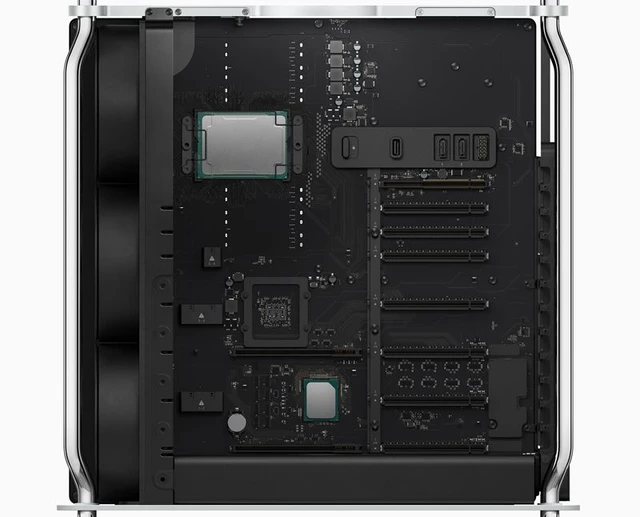
For several iterations, this architectural trade-off served as a primary bottleneck for power users handling massive datasets—such as complex 3D environments or large-scale neural networks. However, the forthcoming M7 Ultra is poised to be the inflection point. Reports suggest that memory support in this chip could reach a staggering 1.5 TB. This would effectively bring Apple back to the benchmarks set by the 2019 Intel-based Mac Pro, which offered immense expansion flexibility via traditional DIMM modules.
The trajectory of this growth is particularly telling. While the upcoming M5 Ultra may set a new generation high with support for up to 768 GB, the M7 Ultra effectively doubles that ceiling. Yet, the technical capacity to support such volumes clashes with a brutal market reality. Amidst a global component supply crisis, Apple has already been forced to prune available configurations for the Mac Studio. Models based on the M3 Ultra saw their 256 GB and 512 GB variants gradually vanish, leaving users with a baseline of 96 GB; reaching the 128 GB threshold now necessitates an upgrade to the M4 Max variant.
The economic implications of such scale are equally provocative. Given Apple's current pricing strategy, scaling memory from a base 128 GB up to the record-breaking 1.5 TB could cost the buyer approximately $35,000. This transforms the workstation from a mere tool into a prohibitively expensive, specialized capital asset.
Ultimately, the M7 Ultra is designed to bridge the historic divide between the blistering speed of unified memory and the sheer capacity of traditional systems. Apple aims to demonstrate that component integration does not necessitate a compromise in professional scalability—even if the path to these terabytes requires overcoming both the physical limitations of silicon and the logistical volatility of the global semiconductor market.
 The Strategic Alliance of Nvidia and MediaTek