Modern autonomous surveillance systems are increasingly predicated on stealth, whether to minimize environmental disturbance or to evade detection entirely. Conventional drones remain easy targets for identification, as the human eye readily recognizes their distinct silhouettes and static structural elements. To counter this, researchers at Northwestern University have proposed a radical paradigm shift: transforming the act of flight itself into a tool for optical deception. The core of this concept leverages ultra-high-speed rotation to effectively erase the object's visual boundaries.
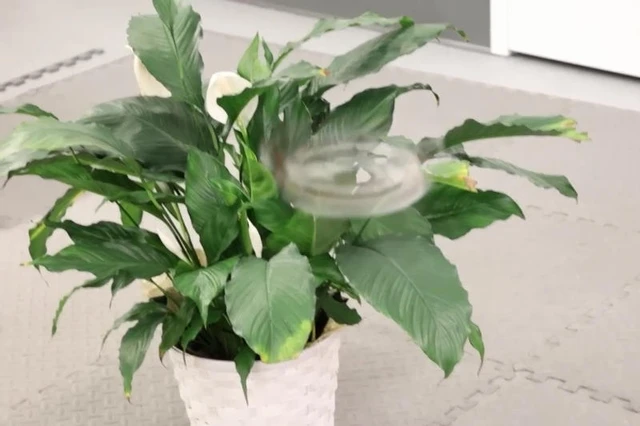
The core of the Phantom Twist prototype lies in a fundamental tenet of human perception: our vision tends to "average" rapidly moving objects, effectively blending them into the background. While a conventional quadcopter relies on a static chassis and four rotors that create a distinct geometric pattern, the Phantom Twist employs fundamentally different kinematics. The aircraft is powered by a single motor and a single propeller; as the screw rotates in one direction, the entire body of the device counter-rotates. At rotational speeds between 15 and 25 revolutions per second, any fixed points vanish, and the drone transforms into an almost imperceptible blur.
Developing such a machine demanded the deep integration of generative design and artificial intelligence. Engineers could not rely on intuitive layout alone, as the equilibrium between aerodynamic stability and visual stealth is precarious. An AI model synthesized approximately 20,000 viable configurations, which were then subjected to rigorous filtering. Algorithms optimized the placement of the battery, printed circuit boards, and motor to minimize the object's spatial density.
For final verification, a specialized visual simulation model was developed to mimic human ocular perception. This model analyzed hundreds of diverse backgrounds, evaluating the visibility of the 500 most promising designs. The result is a configuration where components are staggered across different levels and angles, leaving significant voids between them. This prevents the "solid disc" effect during rotation; because the solid parts of the chassis do not overlap, the aircraft becomes roughly ten times less conspicuous than a standard drone of comparable size.
Despite this technological breakthrough, the Phantom Twist remains an experimental prototype fraught with critical limitations. A primary challenge is the absence of an onboard autonomous positioning system; currently, the aircraft requires an external optical tracking system for navigation. Furthermore, exposed structural elements—such as carbon fiber connecting rods and wiring—still produce visual artifacts.
The most significant hurdle, however, remains the acoustic signature. The high rotational speed inevitably generates noise that betrays the drone's presence, even under conditions of total visual invisibility. Nevertheless, the potential of this technology is immense. The ability to provide a full 360-degree field of view via constant chassis rotation opens new horizons for wildlife surveillance, the surveying of inaccessible wetlands, and technical audits of industrial infrastructure where minimal environmental interference is paramount.
 The Legal Hurdle for Autonomous Taxis