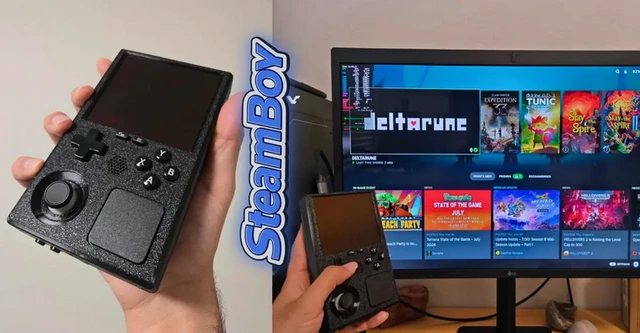
The modern handheld gaming industry is driven by a relentless pursuit of equilibrium—the delicate balance between raw computational power and ergonomic viability. While corporate giants define the standards of comfort, independent engineers are pushing the boundaries of hardware architecture to their absolute limits. The SteamBoy project exemplifies this radical approach to reimagining the form factor of the contemporary gaming PC; it is an ambitious attempt to fuse Valve's uncompromising performance with the legendary, compact footprint of the classic Game Boy.
The notion of shrinking a modern gaming powerhouse to the dimensions of an eight-bit era handheld might seem like a pipe dream. However, the SteamBoy project demonstrates that even the dense architecture of the Steam Deck can be adapted for an ultra-compact chassis. The defining characteristic of this modification is the avoidance of custom PCBs; the engineer successfully integrated the original motherboard, battery, and controller into a footprint nearly identical to that of the original Game Boy.
The new console's chassis measures just 32mm in thickness. This spatial puzzle was solved through strategic component placement: the bulky original battery now spans nearly the entire width of the device, nestled within a narrow gap between the motherboard and the display module. This approach preserves the full functionality of the core power and control systems without requiring a complete redesign of the electrical circuitry.
Thermal management was the project's primary bottleneck, given such a radical reduction in volume. To combat overheating, a custom cooling solution was engineered, featuring a fan and a 30x7mm heatsink secured via 3D-printed mounts. To prevent thermal throttling and critical overheating within the confined space, undervolting was employed—reducing CPU and GPU voltage by 50mV. This stabilized temperatures: lighter titles like Tunic hover around 70°C, while resource-intensive games such as Clair Obscur: Expedition 33 peak at 80°C.
The visual experience presents its own set of technical hurdles. The project utilizes an AMOLED display with a resolution of 1200x1080 pixels and a 90Hz refresh rate, originally designed for VR hardware. At this stage, the panel's integration remains a work in progress; achieving full compatibility with the Steam Deck's ribbon cable requires the development of a specialized adapter board and specific BIOS modifications.
Naturally, such extreme miniaturization demands certain compromises. In its current iteration, the SteamBoy lacks triggers, significantly altering the user experience in modern AAA titles. Nevertheless, the project serves as a vital technical precedent, illustrating the inherent flexibility of handheld PC architecture when approached with rigorous thermodynamic and spatial planning.
 The Evolution of Apple's Augmented Reality Ecosystem