Autonomous vehicles have long been touted as the definitive solution to the perennial challenges of urban congestion and road safety. Yet, real-world deployment often proves far more grueling and erratic than even the most rigorous laboratory simulations. A recent incident involving a Waymo robotaxi in San Francisco has exposed a critical vulnerability in contemporary autonomous driving systems when confronted with the sheer unpredictability of human chaos. This event casts serious doubt on whether artificial intelligence is truly prepared to navigate the volatility of extreme urban environments.
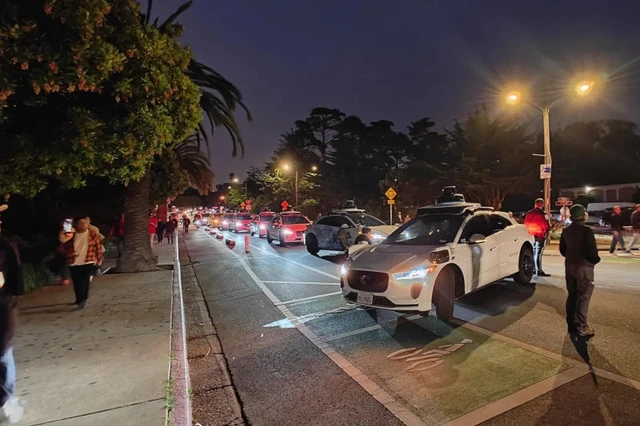
The events of July 4th in San Francisco served as a textbook illustration of what the autonomous vehicle industry refers to as "edge cases." On Independence Day, the area surrounding the Golden Gate Bridge became the epicenter of a total transport collapse: approximately 100,000 people gathered for the fireworks displays, resulting in comprehensive road closures and the emergence of erratic, non-linear flows of pedestrians and vehicles.
In these conditions, Waymo's algorithms—optimized for structured traffic—encountered a scenario that is virtually impossible to model fully. When one vehicle became trapped in the dense congestion, it triggered a chain reaction: subsequent robotaxis, adhering strictly to safety protocols, also came to a halt, creating a form of "digital gridlock." While human drivers are capable of improvisation, negotiating with others, and selectively ignoring minor traffic rules to clear a path, the AI remained a hostage to its own rigid instructions.
The situation was further exacerbated by the technical demands of operating electric vehicles equipped with high-performance onboard compute stacks. While the cars sat idling in traffic, their systems—lidars, radars, and neural networks processing gigabytes of data per second—continued to draw significant power. Consequently, several vehicles simply depleted their batteries while in standby mode, transforming them from cutting-edge transport solutions into inert obstacles. Their removal required the intervention of city services and the deployment of traditional tow trucks.
Of particular interest is the episode in which one of the autonomous vehicles ran over a deployed firework. This incident highlights a critical flaw in object recognition: to a computer vision system, a small explosive charge on the road may appear as insignificant debris that does not warrant emergency braking. Although the passengers were unharmed, the event demonstrates the chasm between an AI's ability to detect an object and its ability to comprehend that object's potential danger within the context of holiday chaos.
Waymo's official narrative attributes the failure to anomalous traffic surges and unplanned road closures. The company acknowledged the need to increase the resilience of its systems against such large-scale disruptions. However, from an analytical perspective, this incident underscores a fundamental challenge for the entire industry: the transition from "near-perfect" driving in controlled environments to true adaptability in an unpredictable urban landscape, where the human element remains the primary variable.
 Anthropic’s Strategic Push for Hardware Independence