The global industrial landscape is undergoing a fundamental paradigm shift, pivoting from rigid automation toward agile, intelligent systems. Modern manufacturing no longer demands mere mechanical repetition; instead, it requires machines capable of adapting to shifting conditions in real time. Toyota is taking a decisive leap in this direction, integrating hundreds of thousands of autonomous units into its global supply chains. This strategy is designed to forge a symbiosis of human expertise and machine precision, fundamentally redefining the very essence of industrial labor.
For years, the Japanese automotive industry viewed anthropomorphic robotics with a degree of skepticism. From the perspective of classical industrial automation, humanoid forms were often seen as superfluous and less efficient than specialized manipulators. However, shifting economic realities and rapid technological progress have prompted Toyota to pivot, initiating the deployment of a massive fleet of 400,000 multi-purpose robots.
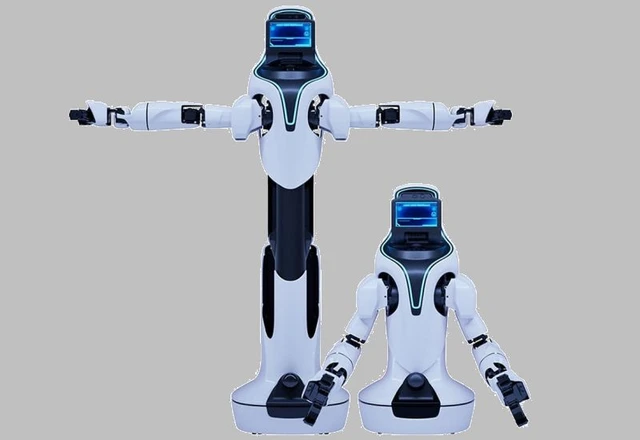
The centerpiece of this strategy is the ELEY series. Eschewing the ambitious but often impractical nature of bipedal androids, ELEY represents a pragmatic engineering compromise: a 50kg robot equipped with a wheeled base for efficient navigation across factory floors. Its functionality is concentrated in long manipulators with precision grippers, enabling it to handle objects of varying shapes and textures—from rigid components to soft fabrics.
The true technological value of the ELEY lies not in its mechanical architecture, but in its capacity for autonomous learning. By leveraging machine learning algorithms to identify optimal trajectories and execution methods, these robots can independently optimize production processes.
The scale of this transformation is staggering. Starting in 2028, Toyota and its subsidiaries intend to invest up to $6.42 billion annually in the modernization of plants worldwide. Of the total fleet of 400,000 units, 150,000 will be deployed within the group's own facilities, while the remaining 250,000 will be distributed across partner plants. This shift has become critical amidst mounting demographic challenges: across 60 Toyota plants, approximately 18,000 highly skilled specialists are employed, whose unique expertise must either be passed to new generations or captured via digital twinning.
The machine training process is facilitated through specialized laboratories that fully simulate real-world assembly line conditions. To transfer skills, Toyota employs an innovative method known as "kinematic mirroring": workers wear specialized devices that record every human movement and translate it into commands for the robot's manipulators. In essence, the machine "absorbs" the muscle memory of a master craftsman.
The efficacy of this approach was demonstrated through a task that is deceptively simple for humans but complex for robotics: folding t-shirts. After 1,500 iterations over two weeks, the robot achieved nearly flawless execution. The key advantage here is scalability: once the software is trained, it can be instantaneously deployed across the entire fleet of identical devices, transforming an individual skill into a network-wide standard.
Ultimately, Toyota aims to create an ecosystem where robots evolve from mere tools into mentors. The vision is for these intelligent machines to train new employees in basic operations, reducing the burden on senior staff and accelerating the onboarding process. This philosophy of coexistence rather than displacement transforms the factory into a hybrid environment, where technological intelligence augments human potential.
 Forecasting Exponential Growth in Nvidia Shipments