The convergence of artificial intelligence and the physical world has emerged as the primary frontier of modern industrial evolution. Toyota, long the gold standard for lean manufacturing, is now pivoting toward the concept of "physical AI" to fundamentally reimagine the nature of mobility. Nvidia provides the computational bedrock for this transition, translating complex algorithms into tangible tools capable of orchestrating physical reality. This alliance signals a strategic shift away from fragmented automation toward the creation of a unified cyber-physical ecosystem.
The contemporary transportation landscape stands on the precipice of a fundamental transformation, where traditional automotive engineering is converging with high-performance computing. For Toyota—a company whose manufacturing ethos has been rooted in optimization and efficiency for decades—the integration of artificial intelligence is the logical evolution of its philosophy of continuous improvement. The expanding partnership with Nvidia marks the beginning of a new chapter in the development of "physical AI"—a domain where neural networks govern not merely data on a screen, but tangible objects within three-dimensional space.
The epicenter of these experiments is Woven City in Shizuoka Prefecture. Far from being a mere testing ground, it is a full-scale prototype of a future urban environment where every street and sensor is integrated into a unified network. The traffic management infrastructure here relies entirely on Nvidia’s hardware and software solutions, effectively transforming the urban environment into an adaptive ecosystem capable of optimizing traffic flows and ensuring pedestrian safety in real time.
Nvidia's technological stack is being woven deep into the very architecture of Toyota vehicles. This extends beyond basic Advanced Driver Assistance Systems (ADAS) toward the creation of fully realized Level 2+ autonomous driving capabilities. The foundation for future commercial vehicles will be the Drive AGX Orin platform—essentially a high-powered mobile data center capable of processing massive volumes of sensor data in real time, ensuring unprecedented precision in maneuvering and situational forecasting.
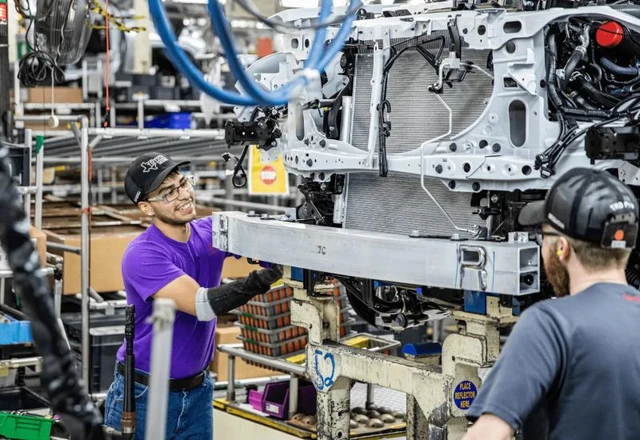
However, the ambitions of these partners extend far beyond the asphalt. A silent revolution is unfolding within Toyota’s production plants: industrial robotics are now being orchestrated via Nvidia's developments and specialized solutions from the startup Ready Robotics. This shifts the assembly line from a deterministic sequence of actions into an agile system capable of adaptation and self-learning.
The primary catalyst for this transformation is the Nvidia Omniverse environment. By leveraging "digital twin" technology, Toyota can create mathematically precise virtual replicas of its factories and assembly processes. Within this digital mirror, engineers can run millions of simulations, test hypotheses, and optimize logistics before a single bolt is turned on the physical production floor. Such an approach radically mitigates risk and accelerates time-to-market for new models.
Jensen Huang's visit to Japan underscores the strategic weight of this alliance. A collaboration that began in 2017 has evolved from simple component procurement into deep technological integration. We are witnessing the birth of a new paradigm, where Nvidia’s computational prowess and Toyota’s manufacturing scale merge into a single mechanism, blurring the line between digital code and physical embodiment.
 Intel’s Strategic Play for Advanced Packaging Supremacy