The race for dominance in synthetic benchmarks is gradually giving way to a more pragmatic pursuit of deep specialization. In an era dominated by proprietary, closed-source systems, the industry is facing a critical demand for versatile foundation models that can be seamlessly adapted to specific enterprise requirements. Thinking Machines Lab is entering the fray with Inkling—a large-scale, open-weights solution designed to shift the very paradigm of AI interaction. The core value proposition has evolved: it is no longer about a model's raw "intelligence," but rather the speed and efficiency with which it can be tailored to the end-user's precise needs.
The emergence of Inkling signals a pivotal shift in the strategy behind large language model development. Rather than attempting to outpace current market leaders in general-purpose intelligence benchmarks, the team at Thinking Machines Lab has focused on engineering a powerful yet malleable foundation. The model boasts an impressive scale: 975 billion parameters implemented via a Mixture-of-Experts (MoE) architecture. This structure allows the system to retain a colossal volume of knowledge while activating only 41 billion parameters per token, significantly optimizing computational overhead during inference.
Inkling’s technical architecture is impressive not only in its scale but in its data breadth. The model underwent pre-training on a massive corpus of 45 trillion tokens encompassing text, images, audio, and video, rendering it truly multimodal. A context window of up to one million tokens places Inkling alongside the industry's most advanced solutions, enabling it to process vast amounts of documentation or extended dialogue chains without losing the thread of reasoning. For use cases where speed and operational cost are critical, a streamlined version—Inkling-Small—is available with 12 billion active parameters.
The real innovation, however, lies not in the metrics, but in the underlying philosophy of the product. The developers openly acknowledge that Inkling may not top every absolute leaderboard. Their objective is to create a "strong base" that can be efficiently tailored to specific scenarios. In this context, the model ceases to be a static product and instead becomes the raw material for creating specialized tools.
Central to this strategy is the Tinker platform. Tinker transforms the fine-tuning process from a complex engineering hurdle into a streamlined, automated pipeline. Through Tinker, developers can implement a full MLOps lifecycle: from uploading proprietary datasets and conducting fine-tuning to final quality assessment and the deployment of new weights.
Demonstration scenarios reveal a level of efficiency that is as daunting as it is impressive. Inkling is capable of autonomously defining its own fine-tuning objectives, preparing the necessary data (for instance, by filtering specific characters from responses), performing quality checks, and independently switching to an updated version of itself. This represents a fundamental transition from the manual orchestration of neural networks toward the creation of self-optimizing systems.
This strategic trajectory is clearly oriented toward the enterprise sector. For large-scale business, a model's general ability to write poetry or solve abstract mathematical problems is secondary to the capacity to rapidly deploy a highly specialized tool that deeply understands internal corporate processes and operates securely with proprietary data.
Ultimately, Thinking Machines Lab aims to build a "model factory." In this conceptual framework, Inkling serves as the universal foundational forge upon which unique, optimized AI versions are crafted for every specific product or business case. This transforms the decision to release open weights from a mere gesture of transparency into a powerful lever of economic and technological influence.

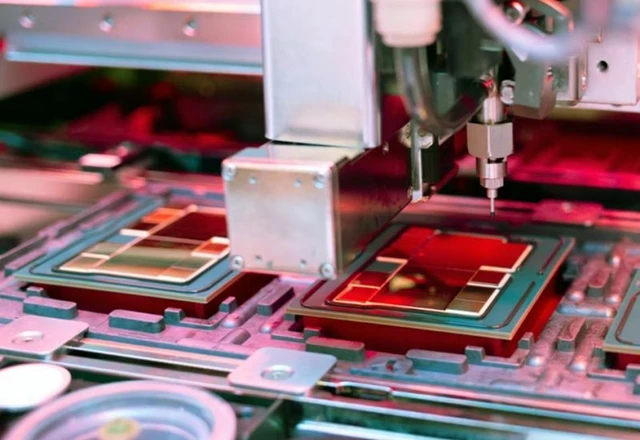 Intel’s Strategic Play for Advanced Packaging Supremacy