The race toward Artificial General Intelligence (AGI) has long since evolved beyond a mere software competition; it has morphed into a visceral struggle for physical resources: power, silicon, and real estate. In its pursuit of exponential model growth, OpenAI is currently navigating a turbulent transformation of its infrastructure management. Recent high-level executive reshuffles signal a fundamental paradigm shift in how the company manages its colossal computational capacity. As it prepares for a potential IPO, the company is overhauling its strategies for data center construction and leasing, scaling its ambitions to astronomical proportions.
In the modern AI landscape, compute power has evolved into the strategic raw material of the era. For OpenAI, the ability to rapidly deploy new GPU clusters directly dictates the iteration speed of its flagship models. This is why the departure of Chris Malone, who has overseen data center (DC) construction since last year, carries significant weight. Malone brought deep expertise forged at Meta and Google, yet his exit is part of a broader, systemic restructuring.
The trajectory of OpenAI's infrastructure development has been marked by sharp pivots. One of its most ambitious undertakings was Stargate—an initiative to build a network of data centers with projected investments reaching $500 billion over four years. While the company initially looked to Oracle and SoftBank for support, the project encountered formidable obstacles. Consequently, OpenAI was forced to recalibrate: rather than attempting to build everything from the ground up, the company has shifted toward more flexible contracts with third-party cloud providers.
This represents a critical strategic evolution. Where OpenAI previously leased individual accelerators, it now seeks to lease entire data center facilities. This shift allows for more efficient management of power consumption and thermal regulation—factors that are mission-critical when operating modern high-performance chips. However, the stewardship of this process is now transitioning to a new leadership team.
Many analysts view the wave of executive departures seen since the start of the year as preparation for an Initial Public Offering (IPO). Streamlining the leadership hierarchy and redistributing roles allows the company to build a more resilient structure, capable of withstanding public scrutiny and meeting the rigorous demands of institutional investors.
Significant shifts have also occurred within the infrastructure division. Overall leadership has transitioned to Vice President Sachin Katti. The technical roadmap for compute capacity is now led by Udai Ruddarraju, who has recruited Brent Mayo—a specialist poached from xAI. Notably, both Ruddarraju and Mayo possess experience working on the Colossus supercomputer in Tennessee, highlighting a broader trend of elite engineering talent migrating between the world's leading AI labs.
Despite this internal turbulence, OpenAI's financial ambitions continue to scale. Infrastructure investment plans through 2030 have been revised upward: instead of $600 billion, the company now intends to allocate $750 billion toward these goals.
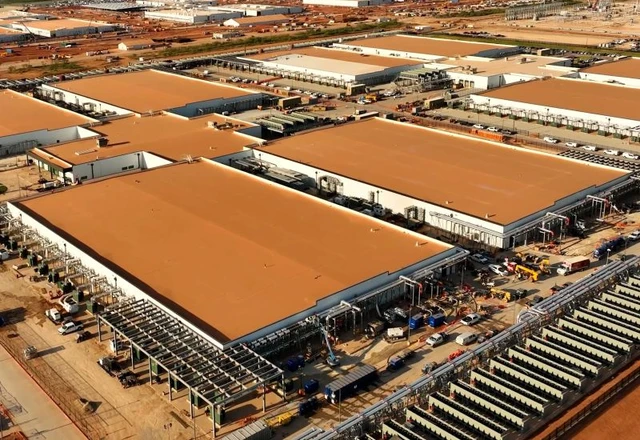
Tangible proof of these ambitions arrived with a recent agreement with a SoftBank subsidiary to lease data centers with a 10 GW capacity in Ohio. Of particular interest is Nvidia's role in this deal; by acting as a guarantor, the chip giant has effectively positioned itself as the primary guarantor of OpenAI's physical viability and scalability.
 The Speed Limits of Modern Gaming Displays