The quest for absolute photorealism in gaming has long since shifted from a reliance on raw hardware power toward the realm of intelligent data reconstruction. Nvidia's latest DLSS 4.5 update marks a pivotal evolution in lighting and shadow rendering, introducing a more sophisticated approach to ray processing. The integration of a second-generation transformer model fundamentally transforms the perception of dynamic scenes while drastically minimizing visual artifacts. Now available across the entire RTX ecosystem, this technology effectively bridges the gap between GPU generations.
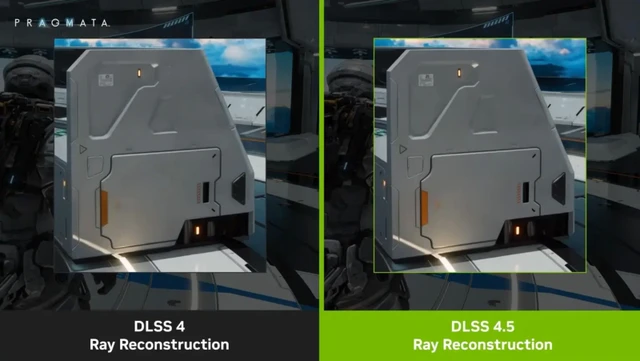
Modern real-time rendering is grappling with a fundamental paradox: full-scale ray and path tracing demand prohibitive computational overhead that even the most powerful GPUs cannot sustain without compromise. For years, the industry relied on denoising algorithms to bridge this gap, but these often came at the cost of visual fidelity, introducing smearing artifacts or ghosting behind moving objects. Nvidia’s answer to this challenge is Ray Reconstruction, a technology that has now received a massive overhaul in the DLSS 4.5 update.
At the heart of this iteration lies a second-generation transformer-based model. This is far from a superficial upgrade; it is a profound architectural redesign of data processing mechanisms. The new model boasts 35% greater computational throughput and operates with 20% more parameters than its predecessor. Remarkably, this increase in complexity has not degraded performance—meticulous optimization has allowed Nvidia to maintain existing FPS levels while significantly elevating the final image quality.
This technical leap was achieved through the utilization of vast training corpora and the fine-tuning of temporal accumulation pipelines. Ray Reconstruction effectively supplants traditional denoisers by integrating the image restoration process directly with DLSS Super Resolution algorithms. By analyzing spatial and temporal data alongside real-time telemetry from the game engine, the system can reconstruct missing pixels from the ray-tracing pass with surgical precision. The result is flawless temporal coherence and razor-sharp detail, even in the most dynamic scenes.
The accessibility of this update is particularly noteworthy. Nvidia is extending Ray Reconstruction to the entire GeForce RTX ecosystem, spanning from the 20-series through to the latest 50-series hardware. This signals a strategic pivot for the company: moving away from strict hardware-gating of features toward the establishment of a unified software standard for visual quality.
Currently, these features are available via the early access channel within the Nvidia App. To activate the technology, users must navigate to the application settings and enable beta versioning. Within games, management is handled via driver settings, where users are encouraged to select the "Recommended" option or the specialized "Preset F" in the DLSS override menu to achieve maximum reconstruction quality.
Beyond the visual enhancements, the Nvidia App update introduces critical system-level optimizations. The implementation of customizable Resizable BAR and G-Sync Pulsar elements, alongside full support for borderless windowed mode, allows for more flexible optimization of the interface between the GPU, the OS, and the display. A stable, general release of these innovations is expected in September, effectively finalizing the industry's transition to a new standard of intelligent rendering.
 The Speed Limits of Modern Gaming Displays