The global race to achieve fully autonomous driving has evolved into a fundamental debate over the very nature of perception. At the heart of this conflict lies a clash between a minimalist philosophy—relying exclusively on vision-based systems—and the sophisticated approach of sensor fusion. This discourse transcends a mere choice of hardware; it probes the boundaries of mathematical reliability and operational safety. An analysis of the strategies employed by the industry's key players reveals why relying on a single "sense" may prove to be an insurmountable hurdle on the road to the widespread commercialization of autonomous vehicles.
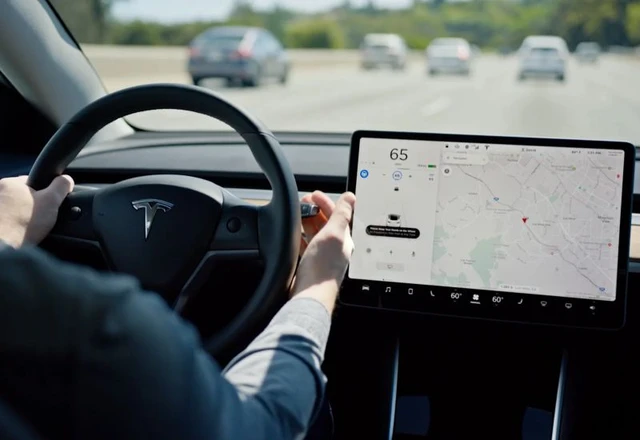
The autonomous vehicle industry has recently witnessed a fundamental schism in control system architecture. One of the most audacious and contentious moves has been Tesla's trajectory toward aggressive hardware minimalism. First, radars were phased out of new models; subsequently, ultrasonic sensors were eliminated, effectively shifting the entire Advanced Driver Assistance System (ADAS) onto a vision-only paradigm.
This strategy is rooted in an anthropomorphic premise: that for a human, eyes and a brain are sufficient for navigation. In this conceptual framework, eight cameras serve as the visual organs, while proprietary neural networks and specialized processors handle cognitive data processing. However, this bet on "pure vision" has sparked significant skepticism among experts and competitors, who argue that such an approach lacks the redundancy required to guarantee absolute safety.
The Achilles' heel of a vision-only method lies in its susceptibility to environmental variables. Cameras are inherently vulnerable to lighting conditions—ranging from blinding glare to the deep shadows of an urban night. Furthermore, physical obstructions, such as mud or accumulated debris, can instantaneously "blind" the system, transforming a high-tech autopilot into a liability for all road users. In the event of a sandstorm or dense fog, the visual data stream becomes too noisy to construct a reliable model of the surrounding environment.
In contrast, the approach championed by Waymo is based on the principle of sensor fusion. Here, supplementary sensors do not merely duplicate the functions of cameras; they create a high-fidelity, multi-dimensional spatial map that no single sensor type could achieve alone. Lidars provide millimeter-precision regarding the shape and relative position of objects regardless of ambient light, generating a detailed point cloud of the environment. Radars, meanwhile, efficiently measure velocity and distance even through heavy precipitation or smoke. Only by synthesizing these disparate data streams can a comprehensive level of situational awareness be achieved.
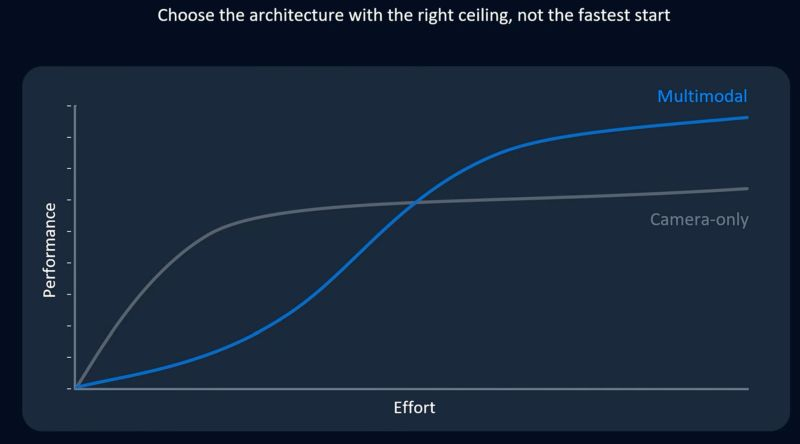
From a technical standpoint, multi-modal perception systems demonstrate superior learning efficiency. There exists a definitive performance ceiling—a "plateau"—beyond which the development of camera-only systems begins to decelerate. The mathematical challenge of achieving absolute safety is that moving from 99% reliability to "five-nines" (99.999%) requires an exponential increase in both data and computational effort. This barrier is precisely why systems limited to a single sensor type face chronic delays in achieving full Level 5 autonomy.
Empirical evidence supports the superiority of the integrated approach. Operational data from Waymo prototypes, covering 352 million kilometers, demonstrated safety metrics 17 times better than those of the average human driver. In the realm of autonomous transport, reaching human parity is insufficient; automation must be orders of magnitude safer to secure regulatory approval and market trust. Experience suggests that bridging this safety gap is virtually impossible without the integration of lidars and radars.
 Meta’s New Era of Visual Interaction