The meteoric rise of Large Language Models has laid bare a fundamental bottleneck in modern computing: the "memory wall," where data throughput fails to keep pace with raw processing power. To break through this impasse, the industry requires a new generation of hybrid architectures—solutions capable of marrying massive storage capacities with the blistering bandwidth typically reserved for volatile memory. The emergence of the High Bandwidth Flash (HBF) specification signals a paradigm shift in how data is orchestrated within AI systems. This standard is designed to radically optimize the inference pipeline, slashing power consumption and significantly lowering the total cost of ownership for AI infrastructure.
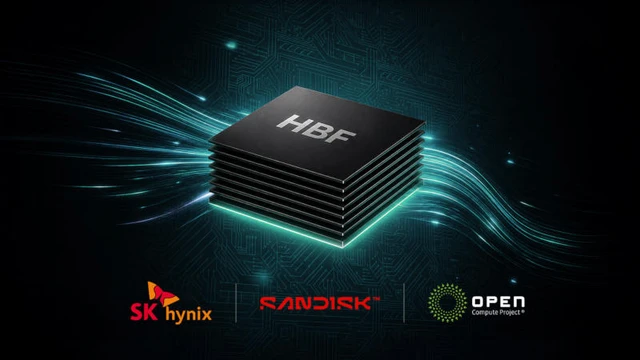
Modern machine learning systems are grappling with a fundamental paradox: while they demand massive datasets to manage neural network weights, access to this data must be near-instantaneous. Traditional memory hierarchies frequently become the primary bottleneck, throttling the performance of even the most powerful accelerators. In response to this challenge, SanDisk and SK hynix, in collaboration with the Open Compute Project (OCP) consortium, have introduced the High Bandwidth Flash (HBF) technical specification.
The standard was developed within a dedicated working group, where key roles were played not only by hardware manufacturers but also by the world's largest cloud infrastructure providers. The involvement of Google and Tensorrent in the standardization process allowed the technology to be validated against real-world production workloads, evolving a theoretical concept into a practical tool for designing data inference systems.
At its technical core, HBF establishes a unified framework for interaction between compute cores and storage. The specification details the xPU-HBF interface, which acts as a high-speed bridge between the accelerator and memory to minimize packet latency. Beyond electrical characteristics and system interfaces, the standard regulates memory stack packaging and reliability requirements—factors critical for densely packed server racks where thermal management and signal integrity dictate overall system efficiency.
A pivotal aspect of HBF is the optimization of the software stack. The specification provides comprehensive guidelines for read/write operation development, enabling engineers at the driver and library levels to manage data streams more effectively and eliminate compute idling. This transforms flash memory from a passive repository into an active element of the data processing pipeline.
Publishing the specification through the Open Compute Project underscores a strategic maneuver by its architects. An open standard prevents vendor lock-in and fosters a broad ecosystem of compatible devices. By establishing a common set of rules, SanDisk and SK hynix aim to position HBF as the industry benchmark for AI storage systems, striking the critical balance between high write density, energy efficiency, and access speeds required for the next generation of intelligent services.
 Forecasting Exponential Growth in Nvidia Shipments