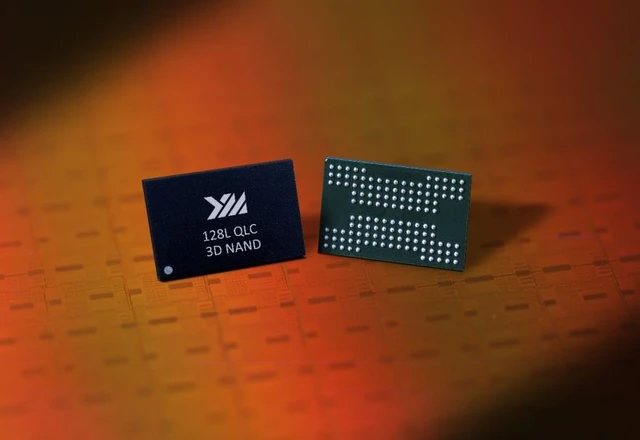
The global semiconductor landscape is undergoing a tectonic shift, with power pivoting toward new centers of influence. The AI revolution has ignited an unprecedented demand for high-capacity storage, transforming NAND flash memory from a mere commodity into a critical strategic asset. Against this backdrop, China's YMTC is positioning itself for a massive offensive to secure a dominant foothold in the global market. The company's strategy blends aggressive financial scaling with profound technological breakthroughs in 3D NAND architecture.
The global memory market is currently navigating a phase of profound transformation. According to data from Counterpoint Research, YMTC has already cemented its position among the top three flash memory manufacturers, commanding a 14% global market share as of the second quarter of this year. However, the company's leadership views these gains as a mere stepping stone. YMTC’s ambitions are far more aggressive: by the end of 2027, the manufacturer intends to emerge as the absolute leader in the NAND segment.
To realize this vision, the company is preparing for a public debut. Through its upcoming IPO, YMTC expects to raise approximately $5 billion. This capital is intended to fuel two critical strategic pillars. The first portion will be allocated toward the physical expansion of production capacities to scale output. The second, and equally vital, component—roughly one-third of the total funds—will be invested in research and development. The focus here is the engineering of next-generation 3D NAND, where competitiveness is defined by bit density and the number of vertical layers within the memory cells.
The company's financial projections are striking: under an optimistic scenario, YMTC's valuation could reach $150 billion, potentially making it the second-largest player on the Chinese stock market. Nevertheless, the path to these figures is fraught with regulatory headwinds. There is a distinct possibility that government authorities may cap the offering price, which could slash the final valuation significantly compared to initial estimates.
YMTC may look to CXMT, a specialist in DRAM memory, as a successful precedent. CXMT's market debut was a landmark event: with a valuation of $580 billion, it became China's most valuable public enterprise, raising $9 billion. This case underscores the insatiable investor appetite for the semiconductor sector and validates the viability of an aggressive growth strategy.
The primary catalyst for this surge has been the boom in generative artificial intelligence. The massive datasets required to train and operate neural networks demand exponential growth in storage capacity. Statistics from TrendForce vividly illustrate this scale: while the global NAND market was valued at $71 billion last year, it is set to surpass the $300 billion threshold this year, approaching $490 billion by the end of the decade.
Despite concerns from some investors regarding potential overcapacity due to the rapid scaling of Chinese players, the market consensus remains bullish. Demand for high-performance memory is outstripping the industry's ability to increase supply. In the current climate, the risk of market saturation appears minimal, as the technological hunger of the AI era consumes any volume of new supply.
 The Speed Limits of Modern Gaming Displays