The global surge in demand for AI compute has catapulted video memory (VRAM) into one of the most critical bottlenecks of the modern tech industry. While hardware vendors maintain rigid product segmentation strategies to protect their margins, Asia's grey market is pioneering ingenious workarounds to bypass these artificial hardware constraints. In China, there is a proliferation of mass-produced modified GPUs, where consumer-grade cards are being repurposed into professional-tier tools. This trend underscores the desperate market hunger for accessible, high-capacity VRAM essential for operating large-scale neural networks.
A significant number of modified GeForce RTX 40-series graphics cards have surfaced on China's secondary electronics market. Specifically, RTX 4080 models are appearing with their VRAM artificially expanded from the base 16GB to 32GB of GDDR6X. These devices command a substantial premium over standard market rates, frequently crossing the 10,000 yuan threshold.
Technically, this modification involves replacing stock memory chips with higher-density modules. However, a physical increase in capacity does not translate to an automatic performance boost across all metrics: the memory bus remains fixed at 256-bit, meaning bandwidth is unchanged. For the GPU to correctly recognize and utilize the expanded VRAM, configuration parameters must be altered via BIOS modifications or specialized software.
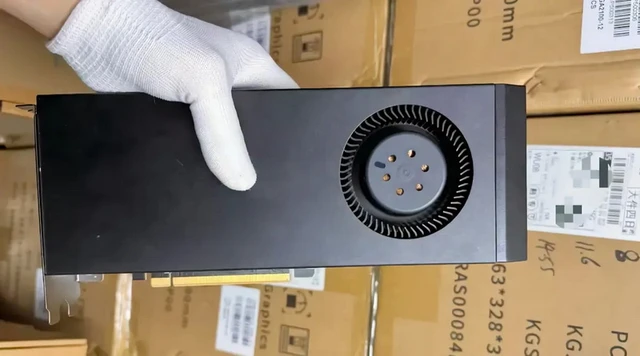
This process has evolved beyond the realm of isolated enthusiasts or boutique repair shops. While similar experiments were previously seen with flagship RTX 4090 and 4090D models—pushed to 48GB—and certain RTX 4080 Super variants, the mass influx of modified standard RTX 4080s signals the emergence of a full-fledged shadow market. A comprehensive ecosystem for reselling "upgraded" hardware has formed, often featuring reinforced cooling systems with radial fans to offset the increased thermal loads.
From an operational standpoint, these devices are a precarious proposition. They are entirely devoid of support from Nvidia and its official partners, and all factory warranties are voided. Software stability is a primary concern; users often rely on modified drivers that must be manually updated every time a new version of a game or professional application is released.
The long-term reliability of such solutions remains an open question, depending entirely on the quality of the soldering and the precision of the chip replacement process. Nevertheless, for a specific class of users—primarily machine learning and generative AI specialists—an RTX 4080 with 32GB of VRAM is highly attractive. In LLM training or Stable Diffusion workflows, VRAM capacity is the critical bottleneck determining whether a model can even be launched. In this context, a modified card serves as a more accessible and cost-effective alternative to both the flagship RTX 4090 (with its 24GB) and prohibitively expensive professional accelerators.
 The Price of Acceleration: CXMT’s Rapid Push into Memory