The modern mobile processor market is pivoting away from general-purpose versatility toward deep specialization. Qualcomm continues to diversify its flagship portfolio, tailoring silicon architecture to meet specific workloads and the nuanced requirements of its partners. The introduction of the V-series underscores the company's commitment to striking a precise equilibrium between power efficiency and peak gaming performance. This strategic shift signals a new era of bespoke SoC customization tailored for distinct device segments.
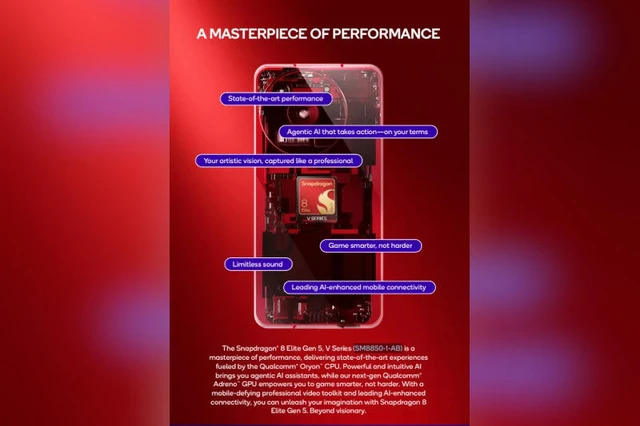
The mobile technology industry is entering an era of "silent iterations," where pivotal shifts are revealed not through flashy keynotes, but within the granular detail of technical documentation and hardware specifications. This is precisely how Qualcomm introduced the Snapdragon 8 Elite Gen 5 V-series, designated as the SM8850-1-AB. Engineered for the upcoming Redmi K100 Pro, this chip is a specialized modification of the flagship silicon, with a strategic pivot toward gaming optimization.
The architectural bedrock of the V-series remains identical to the base flagship. It is powered by custom Oryon cores: two high-performance cores clocked up to 4.6 GHz and six efficiency cores running at 3.62 GHz. The Adreno GPU operates at 1.2 GHz, providing the necessary throughput for rendering complex scenes. Complementing this is the Hexagon NPU, the cutting-edge X85 5G modem, and the FastConnect 7900 connectivity system. With support for LPDDR5X memory and UFS 4.1 storage, paired with the Spectra ISP, this processor functions as a comprehensive technological powerhouse.
However, a closer inspection unveils a critical distinction that separates the V-series from the standard Snapdragon 8 Elite Gen 5: the capacity of the Adreno High Performance Memory (HPM). While the base version boasts 18 MB, the SM8850-1-AB modification scales this down to 12 MB. This decision likely stems from a desire to optimize thermal dissipation or reduce manufacturing costs without incurring a perceptible performance hit in real-world gaming scenarios.
This release underscores Qualcomm's broader strategy of silicon segmentation within a single processor family. We are seeing an entire ecosystem of SM8850 variants: the standard version (SM8850-AC) serves as the foundation for most flagships, while the SM8850-1-AD—featuring higher clock speeds—is integrated into devices from Samsung, Red Magic, and Lenovo Legion. There is even a specialized seven-core variant, the SM8850-5-AC, developed specifically for foldable devices like the Oppo Find N6.
Despite being marketed as a gaming-centric solution, most of the V-series' "gaming" advantages are universal across the Gen 5 lineup. Technologies such as Tile Memory Heap and Mesh Shading, deep optimization for Unreal Engine 5, Snapdragon Game Super Resolution 2.0, and the Adreno Frame Motion Engine 3.0 are all available in the standard versions. Hardware-accelerated ray tracing remains the hallmark of the entire series, effectively turning any SM8850-powered smartphone into a high-end portable console. Ultimately, the V-series is less of a new product and more of a surgical refinement of an already mature architecture, tailored to meet specific market demands.
 Analog Aesthetics in Digital Execution