Modern data storage systems are frequently viewed as mere consumables, defined by a rigid and finite lifespan. The industry-standard TBW (Total Bytes Written) metric has cast a shadow of inevitable degradation over SSDs, effectively transforming a technical specification into a digital "death clock." Yet, the underlying physics of semiconductors is often far more forgiving than the conservative estimates found in marketing brochures. Real-world experience with legacy hardware demonstrates that the chasm between the official warranty limit and actual hardware failure can be staggering.
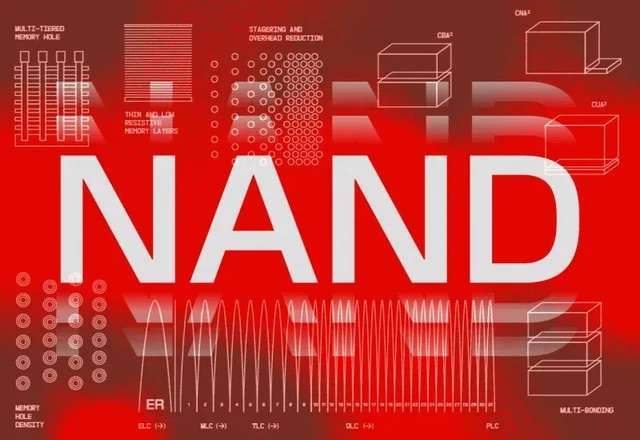
At the core of every SSD lies NAND flash memory, a medium inherently prone to gradual degradation. Each program/erase (P/E) cycle causes physical wear to the dielectric layer within the memory cells, which over time diminishes their ability to retain an electrical charge. To mitigate reputational and financial risks, manufacturers introduce the TBW (Total Bytes Written) metric—the cumulative volume of data a drive is guaranteed to rewrite before critical wear occurs.
There is a deep-seated misconception that reaching this threshold triggers an instantaneous hardware failure or an automatic write-lock. In reality, TBW is not a hard technical limit, but rather a legal and statistical benchmark used for warranty purposes. There is no built-in "kill switch" in memory chips that activates upon reaching a specific data volume; a drive continues to function as long as the physical state of the cells allows for the accurate reading and writing of information.
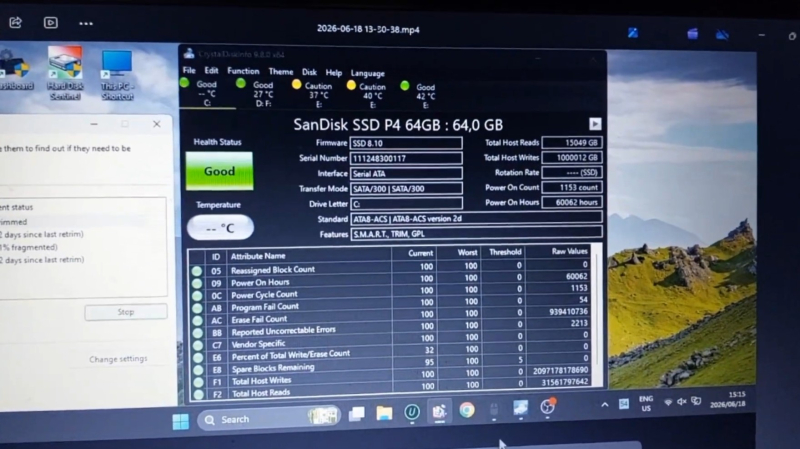
Empirical evidence for this claim can be found in an experiment involving the SanDisk P4, a drive released back in 2010. Originally designed for the OEM netbook and ultrabook market, this model features 2D MLC NAND manufactured using a 32-nanometer process. By modern standards, such hardware appears archaic, yet this simplicity is precisely where its incredible resilience lies.
Unlike contemporary 3D TLC or QLC drives, which pack three or four bits of data into a single cell, MLC (Multi-Level Cell) stores only two. This significantly relaxes the requirements for voltage regulation precision and substantially reduces the wear incurred during each P/E cycle. While modern multi-layered structures strive for maximum storage density, the "good old" planar MLC memory possesses a durability margin that is orders of magnitude higher.
The test results for the 64GB SanDisk P4 were staggering. Despite a rated endurance of 40 TBW, the drive withstood the writing of one full petabyte of data—surpassing the official limit by 25 times. Throughout the experiment, the device logged over 60,000 operational hours and survived more than 1,100 power cycles without showing any signs of catastrophic failure. The workload was intentionally grueling, consisting of continuous cached writes—typically the most taxing scenario for any SSD.
This case highlights a fundamental engineering truth: manufacturers build in significant margins of safety to minimize failure rates and ensure stability under the worst possible operating conditions. While reliability may indeed begin to decline once the TBW is exceeded, the actual lifespan of high-quality components often exceeds the conservative estimates found in specification sheets by tenfold or more.
 The Economic Paradox of the GeForce RTX 5090