Global demand for compute has reached a critical inflection point, transforming semiconductor fabrication into a strategic resource of paramount importance. The AI explosion has acted as a catalyst for a dramatic surge in foundry revenues, which spiked by 29% in the second quarter of 2026. This pursuit of process leadership has evolved into a high-stakes geopolitical struggle between the technological titans of Asia and the U.S. Current dynamics point toward a deep consolidation of the market, where mastery of the most advanced nanometer nodes now dictates global leverage.
The modern semiconductor landscape has long since pivoted toward a model of deep specialization. The bifurcation into fabless companies, which handle chip design, and foundries, which focus exclusively on physical fabrication, has enabled the industry to scale at an unprecedented velocity. Amidst the pervasive expansion of neural networks and generative AI, the demand for specialized accelerators has become the primary growth engine, profoundly impacting the financial performance of the industry's key players.
Taiwan's TSMC remains the undisputed hegemon of this segment. Over the past year, the company has not only fortified its position but increased its market share from 71% to 73%. The secret to this dominance lies in its technological lead: TSMC has focused on the mass commercialization of 3nm and 2nm process nodes. These ultra-precise standards enable the creation of processors with unprecedented transistor density and energy efficiency—metrics that are critical for modern data centers.
Meanwhile, South Korea's Samsung—which balances the roles of contract manufacturer and proprietary component developer—is enduring a period of stagnation. Its market share is steadily eroding: having held 9% a year ago, it has now slipped to 7%. In an effort to close the gap with the leader, Samsung is betting on optimizing the delivery of 4nm and 5nm nodes, coupled with aggressive pricing strategies to offset the loss in revenue share.
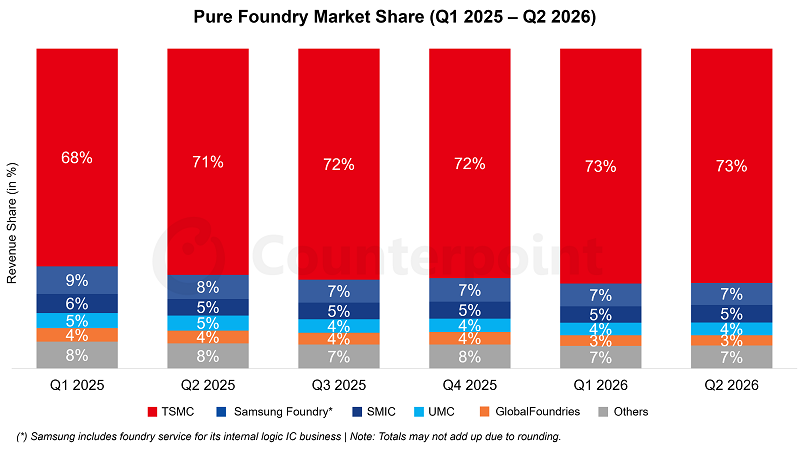
An intriguing dynamic is also unfolding in China. SMIC, holding 5% of the global market, is reporting record financial performance. Despite geopolitical headwinds, the Chinese giant has successfully diversified its order portfolio, serving both the domestic PRC market and international clients. This has allowed SMIC to confidently secure third place in the global rankings, outpacing competitors through production scaling.
Those who failed to adapt to the "nanometer race" are being pushed to the periphery. Taiwan's UMC, once neck-and-neck with SMIC, now commands a mere 4% of the market. The decline is even more pronounced for the US-based GlobalFoundries, whose share has contracted from 4% to 3%, despite significant financial backing from Arabian investment funds.
The overarching trend points toward a level of consolidation that is daunting for smaller players. The five largest corporations now control 93% of total global revenue in the contract manufacturing segment. The market is evolving into an increasingly exclusive club, where the entry ticket costs billions of dollars in lithography equipment, and the right to exist is determined by the ability to produce chips capable of powering the next generation of artificial intelligence.
 MSI Katana 15 HX and the Memory Paradox