Modern multimedia processing demands unparalleled flexibility and peak performance, positioning GStreamer as an essential toolkit for developers worldwide. The release of version 1.28.5 reinforces the framework's strategic trajectory, emphasizing deep integration with contemporary graphics APIs and memory-safe programming languages. Beyond resolving critical bugs, this update expands support for cutting-edge codecs—a pivotal step toward ensuring the stability of streaming and content playback across a diverse array of platforms.
GStreamer has long since transcended its origins as a mere audio and video playback library, evolving into a comprehensive, cross-platform framework. Its capabilities now span the entire multimedia spectrum: from the development of lightweight media players and converters to the deployment of sophisticated VoIP systems and professional-grade streaming infrastructures. The trajectory of recent updates reveals a rapid evolutionary pace; following the releases of 1.24.0 and 1.26.0, the major 1.28 branch was introduced, laying the groundwork for the current update.
The 1.28 branch places a particular emphasis on modernizing hardware acceleration and transitioning toward more secure development methodologies. The integration of Vulkan has enabled the implementation of an efficient H.264 encoder and added support for 10-bit H.265 decoding—a pivotal advancement for HDR content and professional video workflows. Simultaneously, foundational colorimetry support for the Wayland protocol has been implemented, enhancing color accuracy within modern Linux graphical environments.
A significant architectural trend is the strategic migration of components to the Rust language. This shift not only bolsters memory safety but also facilitates the implementation of complex data processing algorithms. Notable additions include audio source separation elements based on demucs, YOLOX inference tools leveraging the burn framework, as well as updated GIF decoders and icecastsink elements with AAC support.
From an infrastructural standpoint, GStreamer maintains its modular architecture and continues to be distributed under the LGPLv2.1 license. The ecosystem is organized into specialized plugin tiers—ranging from base and good to the experimental bad and the proprietary or controversial ugly sets. The system's power is further augmented by the gst-libav wrapper, which harnesses the capabilities of FFmpeg, and the gst-rtsp-server. For the enterprise sector, the preservation of API and ABI backward compatibility with the 1.0 branch remains a critical priority, ensuring the stability of existing deployments during version upgrades.
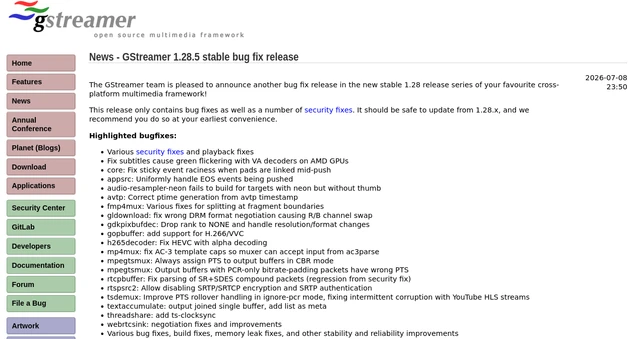
Release 1.28.5 is focused on system refinement and the elimination of performance bottlenecks. The developers have undertaken extensive stability optimizations, resolving memory leaks and fixing core bugs—specifically, an issue involving unstable events during pad linking during data push operations.
Technical enhancements have touched a wide array of specialized components:
- Graphics Stack and Decoding: A persistent green flickering issue with subtitles when using VA-decoders on AMD GPUs has been resolved. In the gldownload component, a DRM format mismatch that caused red-blue channel inversion has been corrected.
- Codecs and Containers: The gopbuffer now supports the cutting-edge H.266/VVC standard, preparing the framework for the next generation of video compression. Additionally, HEVC decoding errors involving alpha channels have been fixed, and the mp4mux multiplexer has been optimized for AC-3 streams.
- Streaming and Network Protocols: Significant work was performed on mpegtsmux regarding PTS (Presentation Time Stamp) assignment in CBR mode, eliminating errors in bitrate filler packets. For YouTube HLS users, intermittent stream distortions have been resolved through improved PTS overflow handling in tsdemux. Furthermore, a regression in rtcpbuffer that emerged following previous security patches has been eliminated.
Additional refinements include increased encryption flexibility in rtspsrc2, which now allows for the disabling of SRTP/SRTCP authentication and encryption, alongside improved consistency in webrtcsink.
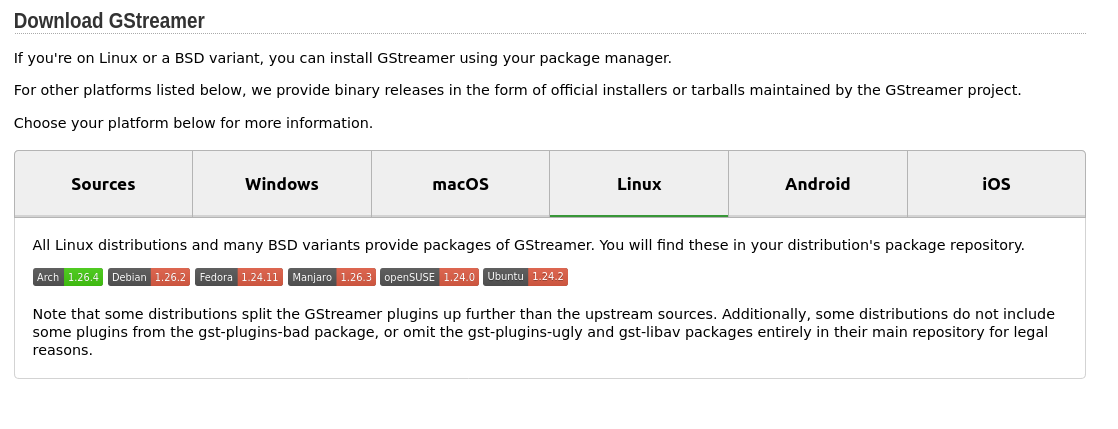
The update is available across all major platforms. While Linux users can rely on their respective distribution package managers, binary builds for Android, iOS, macOS, and Windows will be made available shortly.
 Nvidia’s Technological Pragmatism in the Open-Model Race