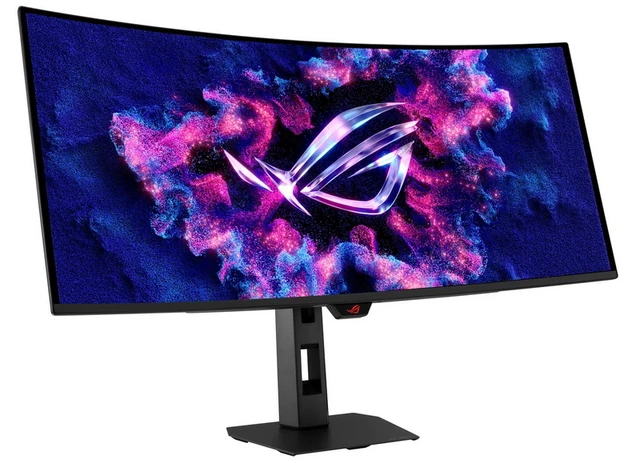
The contemporary gaming display market is rapidly converging toward a singular point: the intersection of absolute color fidelity and extreme response speeds. OLED technology, once viewed as the exclusive domain of home cinema, has firmly established its foothold in the esports arena, delivering a depth of black that traditional panels simply cannot replicate. The new Asus ROG Strix OLED XG34WCDMS stands as the embodiment of this evolution, fusing cutting-edge Tandem architecture with an ultrawide form factor. This device is engineered to redefine the standards of visual immersion for those who refuse to compromise between breathtaking image quality and raw performance.
At the heart of Asus's latest solution lies a curved QD-OLED RGB Tandem panel. The implementation of a tandem structure represents a significant engineering milestone, boosting peak brightness and extending the lifespan of the organic LEDs by distributing the electrical load across multiple layers. With an 1800R curvature and UWQHD resolution (3440 × 1440 pixels), the monitor creates an enveloping spatial effect—a critical advantage for both immersive single-player adventures and expanding the field of view in competitive disciplines.
A 280Hz refresh rate catapults this device into the elite echelon of gaming peripherals. When paired with the near-instantaneous response times inherent to OLED technology, motion blur in dynamic scenes is virtually eliminated. However, Asus has prioritized precision alongside speed. With 99% DCI-P3 color gamut coverage and a Delta E < 2, this monitor is equally suited for professional content creation, where absolute color fidelity is non-negotiable.
Particular attention has been paid to mitigating the traditional shortcomings of OLED matrices. The RGB Stripe Pixel technology is designed to resolve the "fuzzy" text rendering often associated with QD-OLED panels due to their specific subpixel arrangement. The result is significantly sharper typography, transforming the monitor into a more versatile tool for daily productivity. An additional layer of protection is provided by the BlackShield film; it not only increases surface resistance to mechanical damage by 2.5 times but also optimizes black levels, boosting contrast by 40% compared to previous iterations of the technology.
A peak HDR brightness of 1300 nits, coupled with VESA DisplayHDR 500 True Black certification, allows for brilliant highlights while maintaining absolute ink-black shadows. This creates an incredible sense of volume and depth, turning every frame into a cinematic masterpiece.
The issue of pixel burn-in—the primary concern for OLED owners—is addressed here via the intelligent Asus OLED Care Pro system. An integrated proximity sensor monitors the user's presence; as soon as the monitor detects that no one is watching, it automatically shifts the image to black, minimizing the wear on organic compounds and extending the panel's operational lifecycle.
In terms of connectivity, the ROG Strix OLED XG34WCDMS serves as a comprehensive modern hub. It features two HDMI 2.1 FRL ports and a DisplayPort 1.4 with DSC (Display Stream Compression) support, ensuring the transmission of high-refresh-rate signals without quality loss. A USB-C port with 15W Power Delivery and USB 3.2 Gen1 ports allow for a streamlined workspace by minimizing cable clutter.
To ensure flawless visual fluidity, the monitor offers full support for all current synchronization protocols: Adaptive-Sync, Nvidia G-Sync, and AMD FreeSync Premium Pro. This guarantees a tear-free experience regardless of the GPU in use.
Within the broader Asus product hierarchy, this model is positioned as a high-performance solution, surpassed only by the flagship ROG Swift OLED PG34WCDN and its 360Hz refresh rate. Priced at €920, the monitor offers a balanced feature set that brings professional-grade visualization within reach for a wide circle of enthusiasts.
 The Phenomenon of the Foldable iPhone Ultra