Contemporary quality assurance demands tools capable of seamless adaptation to any real-time data transfer protocol. The transition from basic HTTP requests to complex stateful connections has become a critical factor in analyzing the performance of high-load systems. Perfscale 0.6 marks a qualitative leap toward versatility and intelligent orchestration; by integrating modern protocols and AI agents, it transforms a traditional testing tool into a comprehensive monitoring ecosystem.
The evolution of stress-testing tools is currently trending toward radical accessibility and broader protocol support. With version 0.6, Perfscale takes a significant step toward the democratization of its Open Source segment by migrating binary distribution to NPM. Installation is now handled via a single command—npm i -g @perfscale/exe—drastically lowering the barrier to entry for developers and DevOps engineers. Of particular note is the intelligent self-update system: the tool recognizes the installation method and correctly notifies the user of new versions available specifically within the NPM repository, ensuring a seamless support cycle for the OSS version.
The real breakthrough, however, lies in the technical expansion of the core engine. The implementation of full WebSocket support transforms Perfscale from a specialized tool into a universal load-testing powerhouse. Unlike classic stateless requests, working with sockets requires precise management of state and connection lifecycles.
To solve for this, a flexible step-management system has been implemented. Operators can now orchestrate the process in granular detail: from establishing a connection (std/ws-connect) and transmitting data (std/ws-send) to reading messages using sophisticated stopping rules. The introduction of until_contains for substrings and until_json for partial JSON structure matching allows for the creation of scenarios that accurately mimic real-world client behavior, where the system waits for a specific server response before proceeding to the next action.
Complementing these orchestration capabilities is the introduction of a specialized metric: ws_msg_rtt (Application-level Message Round Trip Time). This tracks the duration from message transmission to the receipt of the first response that satisfies a defined rule, enabling latency analysis at the application level rather than just the network stack. Combined with throughput indicators (ws_msgs_sent / ws_msgs_received) and the introduction of "magic variables" (such as seq, choice, and now) now available in the OSS engine, the tool provides deep analytics into system behavior under load.
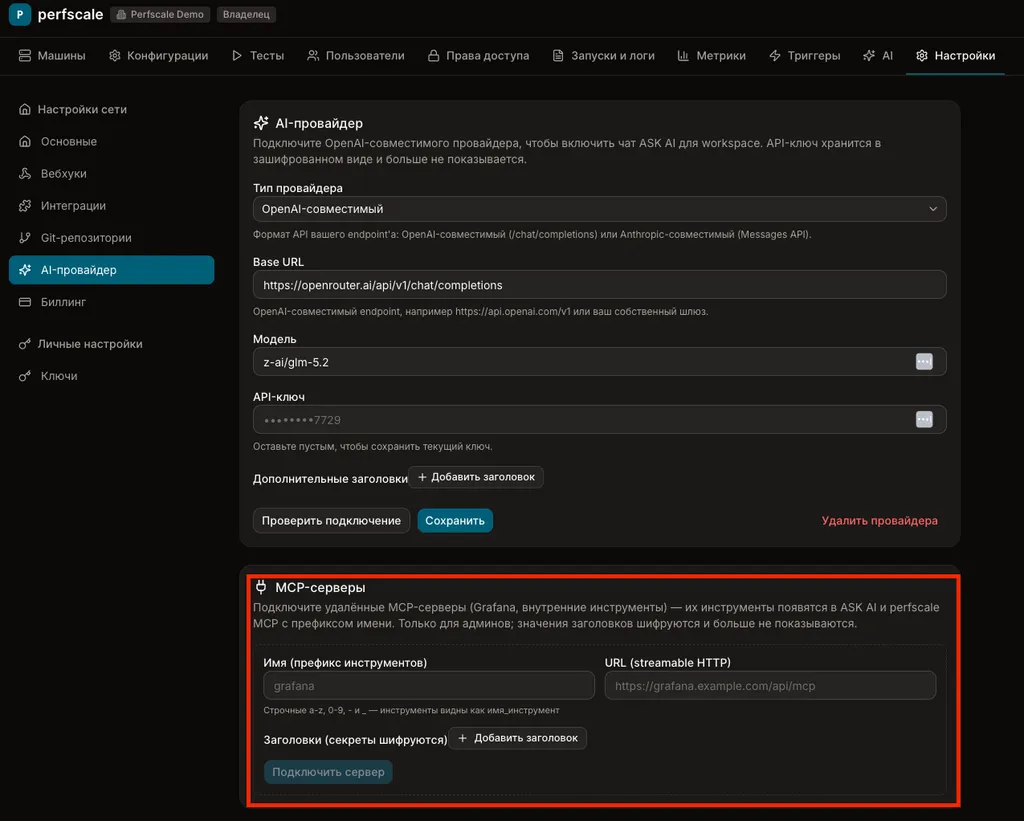
Perhaps the most forward-looking element of this release is the integration with the Model Context Protocol (MCP). This shifts test management from a manual process of interacting with dashboards to a conversational interface. Thanks to MCP, an AI agent becomes a full-fledged control plane operator: it can independently analyze runs, hunt for errors in logs, generate new test scenarios, and adjust configurations directly within the chat.
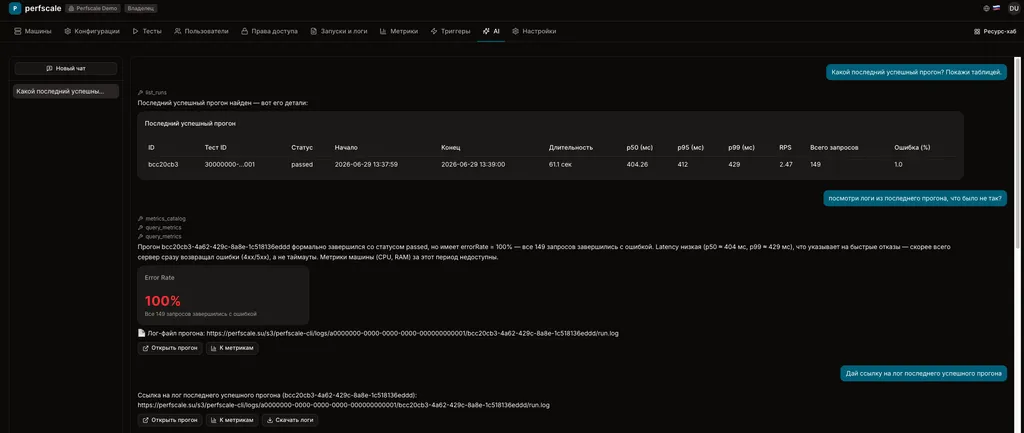
This synergy scales further when integrated with external MCP services such as Grafana, Rootly, or ELK. In this ecosystem, the AI agent ceases to be a mere API interface and becomes an analytical hub. It can correlate data from disparate sources in real-time, aggregate findings, and deliver a verdict on the nature of an issue—whether it is a flaw in the test itself or a defect in the application code. This "inference-based" approach to infrastructure management radically shifts the paradigm of Root Cause Analysis (RCA), slashing diagnostic time from hours to mere seconds.
Looking ahead, Perfscale plans to expand this stack with support for gRPC and WebRTC, firmly establishing the tool as a universal solution for any type of network interaction.
 The Triumph of 3nm Chip Manufacturing