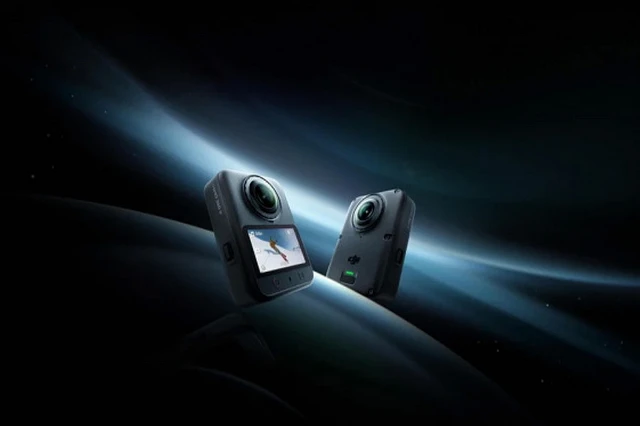
The immersive content industry is undergoing a paradigm shift, evolving from basic panoramic captures toward true cinematic fidelity. Today's rigorous demands for resolution and dynamic range are compelling manufacturers to fundamentally reimagine sensor architecture, pushing for an expansive field of view without compromising optical precision. DJI’s new Osmo 360 II emerges as a definitive response to these challenges, seamlessly blending extreme portability with professional-grade production capabilities. It transforms spatial capture into an art form, ensuring that technical constraints no longer stifle creative vision.
At the core of the updated Osmo 360 II is a fundamental reimagining of image capture. DJI has integrated a specialized one-inch square sensor engineered specifically for panoramic cinematography. Unlike traditional rectangular matrices, this geometry allows for far more efficient use of the sensor's active area, increasing light-gathering efficiency by 25% while maintaining an ultra-wide field of view. The result is uncompromising 8K resolution at 60 fps, delivering a level of fluidity and detail comparable to professional-grade systems.
The device's handling of exposure is particularly noteworthy. With a dynamic range of 14.5 stops, it effectively doubles the latitude of acceptable brightness compared to its predecessor. The ability to independently adjust exposure for the front and rear sensors allows the camera to master challenging lighting scenarios—such as when one lens faces the sun while the other is cast in deep shadow. Combined with 10-bit color depth and the D-Log M profile, the camera evolves into a powerful tool for post-production color grading, offering flexibility typically reserved for full-scale cinema cameras.
For critical lighting conditions, DJI employs the AI Super Night Scene 2.0 noise reduction system paired with an f/1.9 aperture. This enables not only high-quality video recording but also the creation of 120MP panoramic stills and hyperlapses in stunning 16K resolution. For those capturing high-action sequences, a "time-stop" mode at 8K/120 fps opens new horizons for visual storytelling.
In terms of ergonomics and durability, DJI has prioritized practicality. Weighing just 183 grams, the device features a second-generation ultra-hard optical coating resistant to wear and tear. A key engineering breakthrough is the introduction of a removable lens; accidental damage no longer necessitates replacing the entire unit, significantly extending the camera's lifecycle in extreme environments.
Power autonomy is managed by a frost-resistant 2150 mAh battery, capable of sustaining continuous 8K recording (at 30 fps) for 100 minutes. Charging speeds are equally impressive, with the battery reaching 80% capacity in approximately 22 minutes. For extended expeditions, a magnetic external battery system extends operating time by an additional three hours. An internal storage capacity of 105 GB allows for substantial amounts of footage to be stored directly on the device.
The intelligent capabilities of the Osmo 360 II elevate it beyond a mere travel accessory. The AI system now effectively acts as an operator: the subject-tracking feature allows the camera to autonomously keep the target centered in the frame, regardless of how the device rotates or moves. Control has been optimized for "hands-free" operation—voice commands and gestures allow users to trigger recording without touching the camera, a critical advantage for motorcyclists or skiers wearing gloves.
The DJI technical ecosystem continues to expand through hardware synergy. A magnetic mount with a standard 1/4-inch thread ensures compatibility with both proprietary Osmo accessories and industry-standard gear. Furthermore, batteries have been unified with the Osmo Action series, streamlining power logistics when operating multiple cameras. Integration with DJI Mic 3 and Mic Mini 2 via the OsmoAudio protocol completes the package, transforming the device into a comprehensive mobile production kit.
The unit's ruggedness has also reached a new echelon: the camera is waterproof up to 10 meters without additional housing. With the addition of a compact transparent case, this limit extends to 50 meters, establishing it as a fully capable tool for underwater cinematography.
 Anthropic’s Strategic Push for Hardware Independence