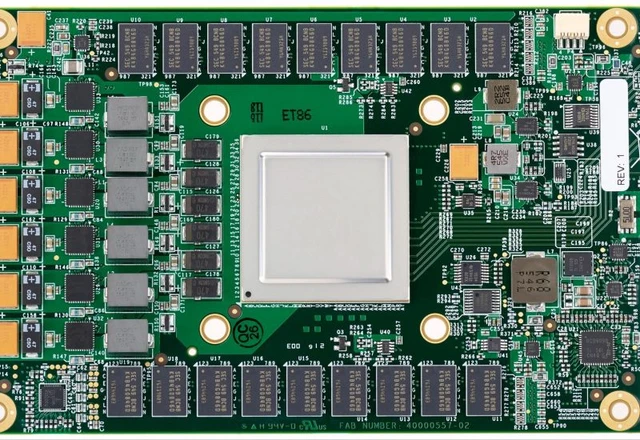
The current AI arms race is pivoting away from raw compute power toward the critical challenge of data movement efficiency. The primary hurdle to scaling neural networks has become the "memory wall"—a bottleneck where the latency and throughput of accessing model parameters throttle overall system performance. The emergence of the HBF standard promises to dismantle this barrier by fusing massive storage capacities with the blistering bandwidth of high-speed interconnects. This paradigm shift stands to fundamentally reshape both the economic landscape and the energy efficiency of modern data centers.
The semiconductor industry is witnessing a pivotal shift: SanDisk and SK hynix, with backing from Tenstorrent and Google, have introduced the HBF memory standard. This development is the culmination of an industry consortium's effort to bridge the fundamental chasm between non-volatile storage and ultra-fast volatile memory.
The primary application for HBF lies in the inference phase—the stage where a pre-trained model generates responses or draws logical conclusions from input data. In modern Large Language Models (LLMs), the sheer volume of weights has grown so massive that relying solely on expensive, capacity-constrained HBM (High Bandwidth Memory) is no longer economically viable. HBF offers an elegant solution: it mirrors the architectural logic of HBM to deliver colossal throughput while maintaining the properties of long-term data persistence.
From a systems architecture perspective, this hybridization significantly reduces latency during data retrieval for computation. Experts at Google DeepMind emphasize that as AI models grow exponentially, the ability to rapidly read massive parameter arrays becomes a critical bottleneck. Furthermore, transitioning to HBF substantially improves the energy efficiency of the overall infrastructure—a top priority for hyperscale data center operators grappling with escalating power consumption and thermal management challenges.
However, such high performance comes with inherent technical risks. The primary concern is cell degradation during intensive rewrite cycles. Theoretically, utilizing HBF as a full-fledged replacement for RAM would lead to rapid hardware failure due to the limited endurance of its program/erase cycles.
To mitigate this, a strategy of role segregation is proposed. The infrastructure must be orchestrated so that HBF is used primarily for read operations—such as storing static model weights. Meanwhile, traditional HBM will handle all dynamic write operations and temporary data caching. This tandem approach offsets the limitations of both technologies: HBM manages the burden of data updates, while HBF provides a scalable, high-speed repository, transforming the inference process into a highly optimized pipeline.

 The Price of Acceleration: CXMT’s Rapid Push into Memory