The generative AI arms race is shifting its focus from the pursuit of absolute fidelity toward operational efficiency and speed. Google is making a bold move in this direction with the introduction of Nano Banana 2 Lite—a tool engineered for near-instantaneous visual synthesis. This model embodies a strategic pivot toward the "good enough" paradigm, prioritizing real-time accessibility over raw power. The industry's center of gravity is moving away from compute-heavy architectures and toward rapid iteration and the rigorous optimization of cost-per-pixel.
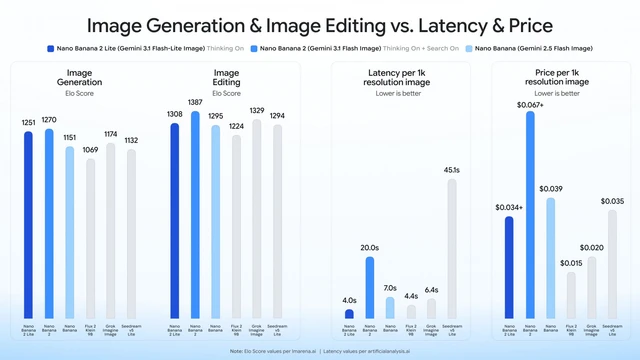
Google has unveiled a new addition to its ecosystem, fundamentally rethinking the approach to visual content generation. The Nano Banana 2 Lite model (identified in the API as gemini-3.1-flash-lite-image) is positioned as the fastest and most cost-efficient member of the company's image generation family. The key metrics are impressive: synthesis time has been slashed to four seconds, while the cost per 1K resolution image stands at just $0.034.
Integration is being rolled out on a massive, systemic scale. The tool is already available to developers via Google AI Studio, the Gemini API, and the Gemini Enterprise Agent Platform. Simultaneously, its capabilities are being woven into consumer-facing services: from traditional Search and the Gemini app to NotebookLM, Google Photos, Stitch, Flow, and Google Ads. Effectively, the Lite version has become the recommended replacement for the first generation of Nano Banana (gemini-2.5-flash-image) for all scenarios where latency and operational costs are critical factors.
Inevitably, such extreme velocity requires a compromise in quality, though the dip is less pronounced than one might expect. According to Elo ratings from lmarena.ai, Nano Banana 2 Lite scores 1251—trailing only slightly behind the full Nano Banana 2 at 1270. Despite this, the "Lite" version comfortably dominates several formidable competitors, outpacing Grok Imagine Image (1174), Seedream v5 Lite (1132), and Flux 2 Klein 9B (1069). Even with its optimization, Google has managed to preserve core competencies: precise adherence to complex prompts, character consistency, and the ability to render legible text within images.
From a strategic product standpoint, the introduction of the Lite version addresses a critical technological gap. The full Nano Banana 2 exhibits a latency of approximately 20 seconds, making it slower than even its predecessor (which clocked in at 7 seconds). This inertia is the result of integrated deep reasoning and web-search capabilities—features that enhance intelligence but sacrifice agility. With its four-second cycle, Nano Banana 2 Lite restores the ultra-fast generation niche to Google's portfolio.
The model's economics are equally noteworthy. While Lite is the most affordable option within Google's own lineup, it does not claim to be the cheapest solution on the market—Flux 2 Klein 9B, for instance, costs $0.015, and Grok Imagine sits at $0.020. Google’s strategy here is not based on aggressive price-cutting, but rather on offering the optimal quality-to-cost ratio.
Implementing the model within the Gemini app is seamless: users simply select version 3.1-Flash-Lite from the dialogue window. Currently, the most effective use case is rapid prototyping and prompt iteration. This allows creators to quickly filter out unsuccessful concepts, reserving the full Nano Banana 2 for the final, high-fidelity rendering of the chosen vision.
 Anthropic’s Strategic Push for Hardware Independence