The TIOBE Index celebrates its twenty-fifth anniversary, capturing a period of fundamental upheaval in the global development landscape. While industry veterans maintain their stronghold, the market is pivoting toward more stringent standards of security and performance. Rust’s ascent into the top ten marks a pivotal paradigm shift in systems programming. Ultimately, this report is more than a collection of search metrics; it is a chronicle of the tangible transformation of the modern technological stack.
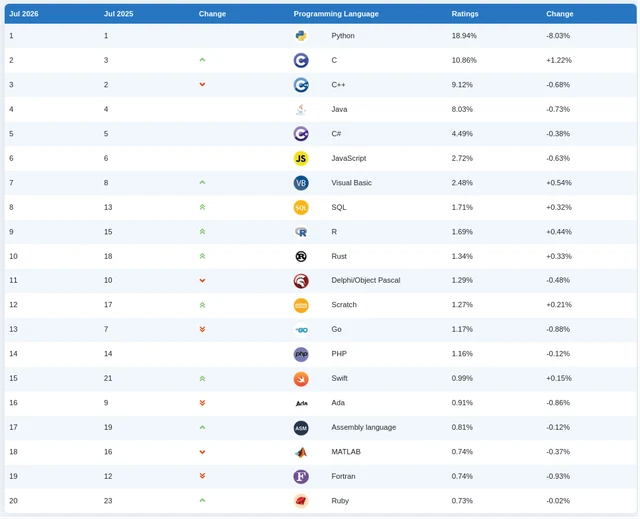
The contemporary hierarchy of programming languages exists as a sophisticated intersection of deep-rooted conservatism and breakneck evolution. Fresh data from the TIOBE Index for June 2026 confirms the astonishing resilience of the "old guard": C, C++, and Java remain at the industry's vanguard a quarter-century later. This stability underscores a fundamental truth: the bedrock of modern software still rests upon technologies that dominated the landscape at the turn of the millennium.
Yet, beneath this surface of stasis, tectonic shifts are occurring. The defining event of the current period is the historic triumph of Rust, which has broken into the top 10 for the first time, climbing from 15th place. This ascent is no accident. Rust emerged as the industry's definitive answer to the perennial struggle with memory vulnerabilities—the primary "malady" afflicting C and C++. By offering rigorous memory safety without sacrificing performance, Rust is effectively challenging the hegemony of traditional systems languages. Despite efforts within the C and C++ communities to integrate modern protection mechanisms, the developmental vector is shifting toward tools where security is baked into the language's core conceptual framework.
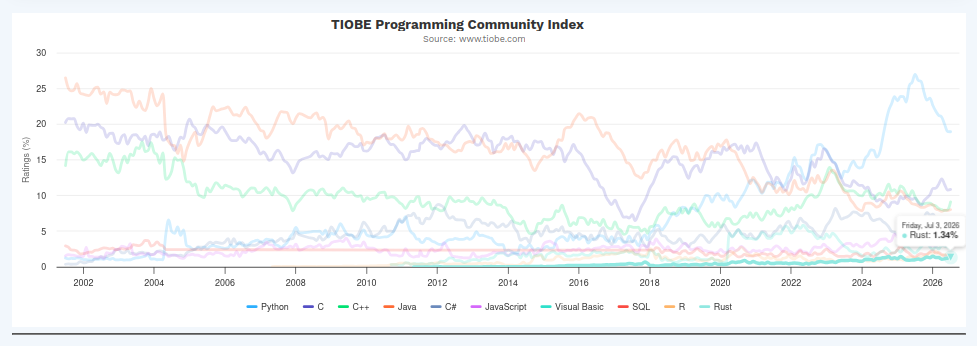
At the opposite end of the spectrum is Python. Despite its status as the world's most popular language, it is showing signs of saturation. While Python hit its zenith last July, commanding nearly 27% of the market, its share had dipped to 18.94% by June 2026. This decline does not signal obsolescence, but rather a process of specialization. Developers are increasingly opting for more niche tools tailored to specific tasks. For instance, R—a powerhouse in the realm of Data Science—has firmly established itself in the top ten, competing directly with Python in the field of data analysis.
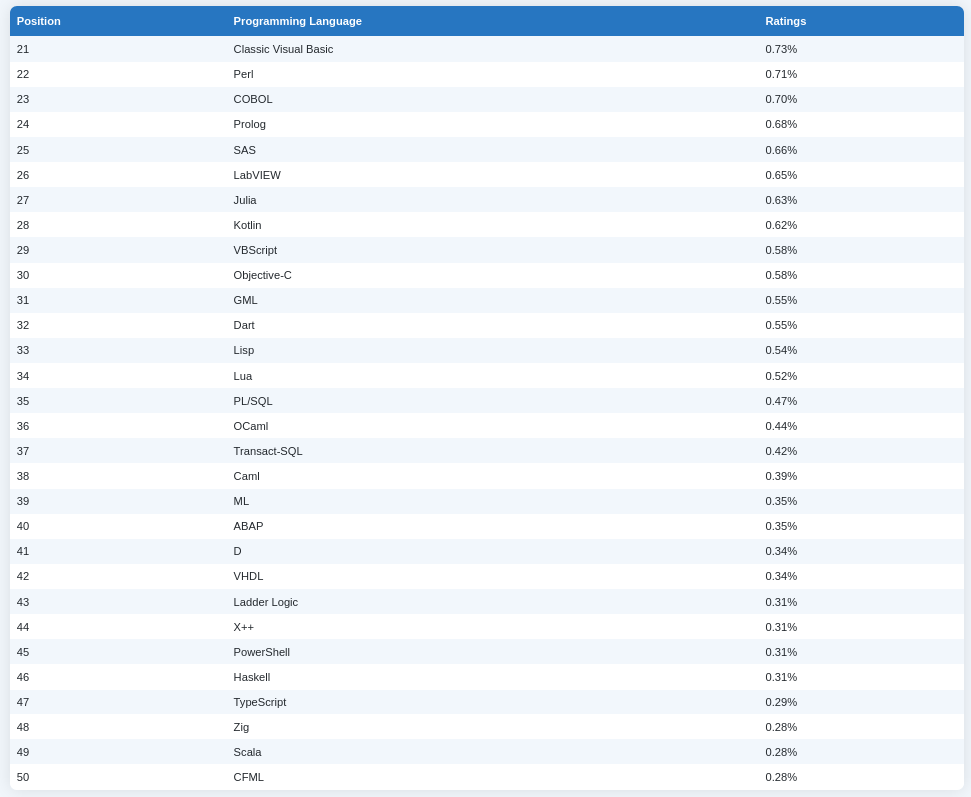
An intriguing phenomenon has been the temporary resurgence of Perl. Long dismissed as a relic of the early automation and system administration era, Perl saw an unexpected spike in popularity in 2025, climbing to 13th place before correcting back to 22nd. This suggests a cyclical nature of demand for scripting tools within specific infrastructural niches.
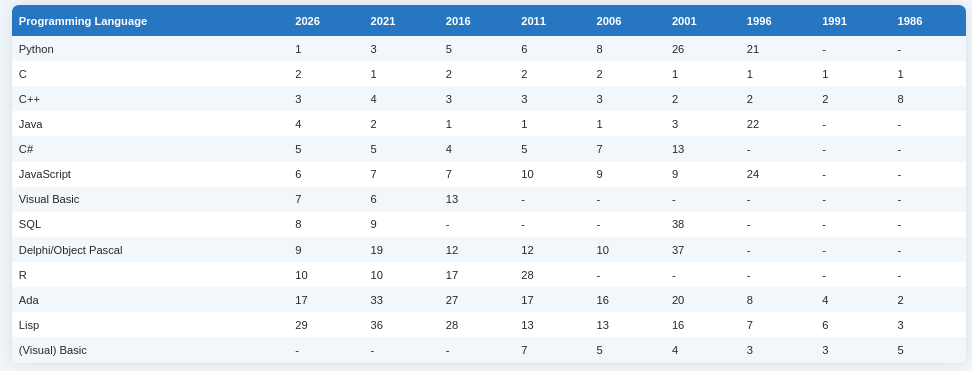
Parallel to these trends, the rankings continue to be haunted by "digital ghosts"—languages such as Ada, Fortran, COBOL, and Delphi. Their return to the top 20 in March 2025 was driven not by fashion, but by the stark necessity of maintaining mission-critical legacy software. Massive codebases in banking systems, aviation, and the public sector continue to operate on decades-old technology, creating a steady demand for specialists capable of supporting them. In this context, even Assembly, which yielded its spot to Ada in the lower reaches of the top twenty, remains an indispensable component of low-level programming.
The TIOBE methodology is based on a deep analysis of search traffic across platforms such as Google, Bing, YouTube, and Baidu, as well as monitoring mentions in professional blogs and social networks. This renders the index a barometer of market "interest" and "demand," though the authors themselves emphasize that a language's popularity does not always equate to its optimality for a specific project. To help developers bridge this gap, TIOBE has announced the launch of the Programming Language Flowchart—an interactive guide designed to navigate stack selection based on specific business objectives.
Beyond the top ten, a battle for attention is unfolding across a broad spectrum of languages—from Solidity for smart contracts and Elixir for high-load systems to specialized tools like Wolfram or V. The list from 51st to 100th place, featuring names like Clojure, Erlang, and F#, demonstrates the incredible diversity of approaches to solving computational challenges in the modern world.
 The Speed Limits of Modern Gaming Displays