Version control systems have long since evolved beyond simple change-tracking utilities, becoming the very bedrock of modern software engineering culture. The release of Git 2.55 marks a pivotal milestone—one that not only streamlines day-to-day workflows but strategically paves the way for the eventual transition to version 3.0. Development efforts have centered on scaling performance for massive repositories and the incremental integration of modern systems programming paradigms. This release underscores the project's maturity, with every refinement meticulously designed to reduce friction between the engineer and their codebase.
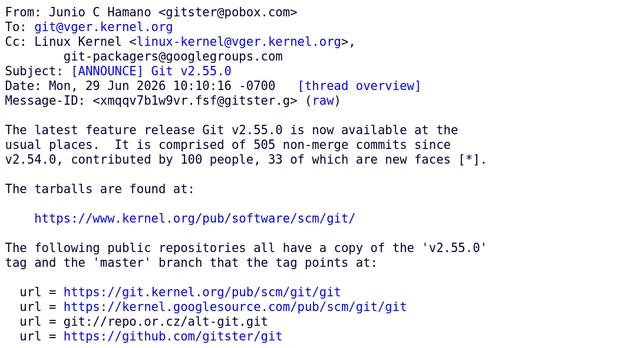
Git 2.55 arrives as a substantial iteration, consolidating over 400 changes and contributions from nearly 150 developers. While the release eschews a single "headline" feature, it focuses on the meticulous polishing of the tools that millions of programmers rely upon daily. More importantly, it serves as a strategic bridge toward version 3.0, which promises to be a landmark milestone in the system's evolution.
One of the most significant strategic shifts is the integration of the Rust language. Previously, Rust support was optional and required manual configuration via build flags; in version 2.55, it is enabled by default. This move lays the groundwork for Git 3.0, where Rust tooling may become a mandatory dependency. The transition to Rust is driven by a commitment to enhanced memory safety and increased performance across critical system bottlenecks—a necessity when processing colossal volumes of data.
For those managing monolithic projects, Git 2.55 introduces tangible improvements in repository maintenance. The implementation of incremental multipack indices via the git repack -write-midx=incremental command significantly optimizes data storage and access. Simultaneously, the generation of object availability bitmaps—one of the most resource-intensive processes during repacking—has been substantially accelerated. According to benchmarks, execution time for this operation in large repositories has been slashed by more than half, dropping from 612 to 294 seconds.
A pivotal update for Linux users is the full support for the native FSMonitor filesystem monitoring daemon. Previously available only on macOS and Windows, Git now leverages the Linux kernel's inotify subsystem. This fundamentally transforms how git status operates: rather than scanning the entire working tree, the system simply queries the daemon for a list of modified files. While extremely large projects may require adjusting the fs.inotify.max_user_watches limit, the resulting boost in repository responsiveness more than justifies the configuration effort.
The developers have also reimagined the approach to history revision and automation. The experimental git history command allows users to modify old commits without the need for labor-intensive interactive rebasing. This creates a more direct and intuitive path for code correction, replacing the traditional workflow of combining commit -fixup with rebase -autosquash.
In tandem, customizable hooks have evolved. Git now allows compatible checks—such as linting and unit tests—to run concurrently if they are marked as safe for parallel execution. This reduces pre-commit latency, transforming a sequential queue of checks into an efficient multithreaded process.
Regarding daily usability and security, several targeted yet pivotal enhancements have been introduced. The git checkout -m command is now more robust thanks to an internal autosave mechanism that preserves conflicting changes during branch switching. For those managing repository mirrors, support for remote groups has been implemented, enabling changes to be pushed to multiple hosts with a single command. The visual experience also received an upgrade: the -graph-lane-limit option in git log allows users to constrain the width of the history graph, preventing terminal layout distortion when dealing with highly branched topologies.
Finally, it is worth considering the broader ecosystem context. Created by Linus Torvalds in 2005 as a response to the shortcomings of BitKeeper, Git has become the absolute industry standard over the last two decades. Today, a powerful infrastructure of alternative collaboration platforms has coalesced around it. Recent releases like Gitea 1.26 and Forgejo v15.0 LTS demonstrate a steady trend toward self-hosted solutions, empowering teams to deploy full-scale alternatives to GitHub or GitLab on their own infrastructure, maintaining total control over their source code and data.
 The Price of Acceleration: CXMT’s Rapid Push into Memory