The quest to uncover the fundamental laws of the universe has reached a critical inflection point of technological transformation. The Large Hadron Collider—humanity’s premier instrument for probing the subatomic realm—is entering a strategic hiatus for an extensive architectural overhaul. The transition to High-Luminosity mode is engineered to illuminate the mysteries of dark matter and push the frontiers of modern physics. This modernization signals a paradigm shift in the methodologies governing the acquisition and analysis of elementary particle collision data.
On June 29, 2026, one of the most ambitious engineering feats in human history—the Large Hadron Collider (LHC)—officially ceased operations. This shutdown is not a technical failure; rather, it marks the beginning of a planned four-year modernization cycle designed to evolve the facility into the High-Luminosity LHC (HL-LHC). The objective of this transition extends beyond mere performance enhancements: scientists aim to radically increase the probability of detecting dark matter, which constitutes the bulk of the universe's mass yet remains invisible to conventional observation methods.
Situated approximately 100 meters beneath the border of France and Switzerland, the LHC is a monolithic 27-kilometer ring. Within this tunnel, superconducting magnets accelerate protons to near-light speeds, recreating the conditions that existed in the first fleeting moments after the Big Bang. It was here that the Higgs theory was validated and the eponymous boson discovered, providing the key to understanding how particles acquire mass. However, for the next quantum leap in particle physics, current capacities have proven insufficient.
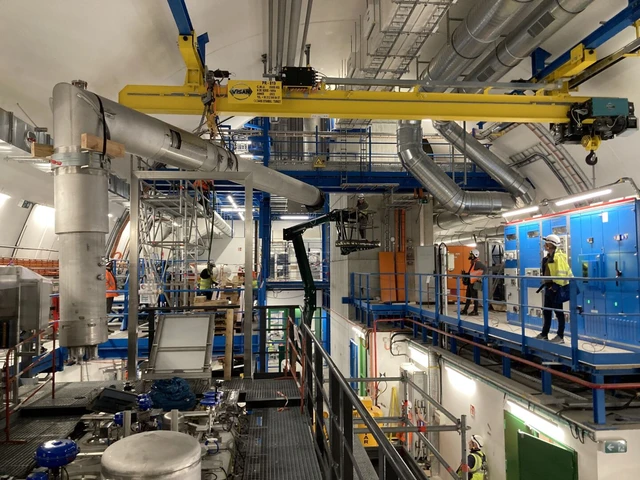
The primary vector of this upgrade is the increase of "luminosity"—the parameter defining the number of particle collisions per unit of time. Under the HL-LHC project, this metric is expected to grow tenfold. To achieve this, engineers must completely overhaul equipment across a 1.2-kilometer section. New superconducting magnets will allow for more precise beam focusing, leading to a sharp increase in event density. While current collisions yield approximately 60 interactions, this figure is projected to rise to between 140 and 200 events following the system's relaunch in June 2030.
The cost of this technological leap is estimated at 1.2 billion Swiss francs (approximately 1.5 billion USD). Funding for the project is global in scope: primary expenses are covered by the membership fees of CERN’s participating states, with significant contributions of equipment and resources provided by the United States, Japan, Canada, and China.
Yet, alongside the expansion of physical capabilities comes an unprecedented challenge in data processing. The torrent of information generated by billions of collisions per second will be so massive that conventional storage architectures will be rendered obsolete. At this juncture, fundamental science converges with cutting-edge IT: event filtering must occur in real time. The responsibility for isolating the most promising data will fall to artificial intelligence systems, which must instantaneously distinguish statistical noise from the potential discovery of a new particle.
The upgraded collider is expected to operate for approximately ten years, providing physicists with a unique instrument to probe the hidden mechanisms of the universe and finally confirm the nature of dark matter.
 Anthropic’s Strategic Push for Hardware Independence