Modern esports demands uncompromising precision and near-zero input latency. In a relentless pursuit of every single millisecond, peripheral manufacturers are evolving beyond incremental upgrades, shifting instead toward the development of comprehensive modular ecosystems. The new ROG Raikiri II Pro emerges as a definitive answer to this challenge, fusing blistering response times with an unprecedented degree of customization. This device fundamentally reimagines the interface between player and system, transforming the gamepad from a mere controller into a high-precision instrument.
At the heart of the ROG Raikiri II Pro lies a relentless pursuit of absolute minimal latency. A wireless polling rate of 8000 Hz catapults the device into the elite tier of gaming peripherals, ensuring near-instantaneous signal transmission. This blistering speed is powered by a high-speed 2.4 GHz radio channel, though the controller maintains versatile connectivity via Bluetooth and a traditional USB-C wired connection.
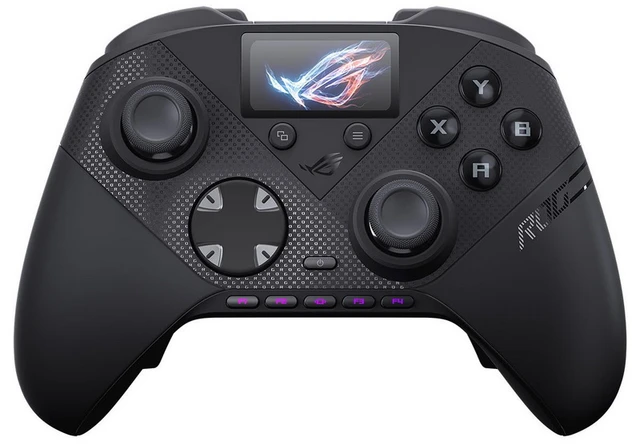
The ergonomics and button layout have been elevated to a standard typically reserved for professional-grade keyboards. Beyond the standard array, the controller features two additional bumpers and five functional F-keys—one of which duplicates the Ctrl key—significantly expanding macro capabilities for PC gaming. Particularly noteworthy are the four removable buttons on the rear panel. All primary controls, including the D-Pad and rear paddles, utilize mechanical switches, guaranteeing a crisp tactile response and substantially extending the component's operational lifespan.
The user interface has evolved toward greater autonomy. The second generation of the controller introduces an expanded color display, transforming the gamepad into a standalone command center. Calibration of the sticks, key remapping, and backlight brightness adjustments no longer require launching software on a PC. The display allows for instantaneous switching between five onboard profiles, although the Asus Gear Link application remains available for deep tuning. An additional advantage is the Turbo mode, which automates rapid-fire inputs to reduce wrist strain during intense fighting game or RPG sessions.
The technological core of the device is defined by the integration of TMR (Tunnel Magnetoresistance) sensors in the sticks. Unlike traditional potentiometers, TMR sensors eliminate the physical wear of contact surfaces, effectively solving the industry-wide problem of "stick drift." The engineers have pushed the boundaries further by implementing a hot-swappable module system. The package includes sticks with different actuation forces—50g and 120g—allowing gamers to choose between effortless glide and maximum resistance for high-precision positioning.
The triggers support a hybrid operational mode. Users can toggle between a standard deep travel, essential for racing simulators, and a short digital click that mimics a mouse press—a critical advantage for competitive shooters.
Battery autonomy has been significantly optimized: in 2.4 GHz mode, the controller can operate for up to 79 hours on a single charge. A comprehensive accessory ecosystem completes the premium experience. The bundle includes not only a protective charging case for transport but also a stationary charging dock, a module replacement tool, and a set of interchangeable thumbstick caps.
The device will be available in a sophisticated black and a minimalist white finish, offering users an uncompromising fusion of high-end engineering and the aesthetics of digital minimalism.
 The Evolutionary Trajectory of the New Apple Watch