For decades, biomimetics has sought to decode the secrets of natural coordination, attempting to translate organic patterns into executable code. Yet, traditional programming often proves too rigid for the volatility of real-world environments, where instantaneous adaptation is paramount. A groundbreaking experiment by Japanese and Thai engineers signals a paradigm shift: moving away from direct replication toward the autonomous mastery of locomotive principles. Machines are now capable of distilling efficient movement strategies simply by observing biological prototypes.
Efforts to replicate the biomechanics of insect locomotion have long been plagued by a persistent paradox: despite the relative simplicity of an insect's central nervous system, their coordination precision in complex environments remains elusive for conventional algorithms. The traditional approach, based on hard-coded trajectory mapping for each limb, lacks the fluidity required for animals to navigate unpredictable obstacles. To break this deadlock, researchers from Tohoku University and the Vidyasirimedhi Institute of Science and Technology (VISTEC) have shifted the learning paradigm entirely.
Rather than prescribing granular movement instructions, the developers implemented a goal-oriented framework. At the core of this control system is an AI model utilizing adversarial reinforcement learning. In this architecture, the agent is not fed explicit commands such as "lift leg" or "shift center of gravity"; instead, it is incentivized through rewards for achieving stable and secure limb positioning. Consequently, the AI autonomously discovers the optimal path to the objective, synthesizing its own movement patterns through iterative trial and error.
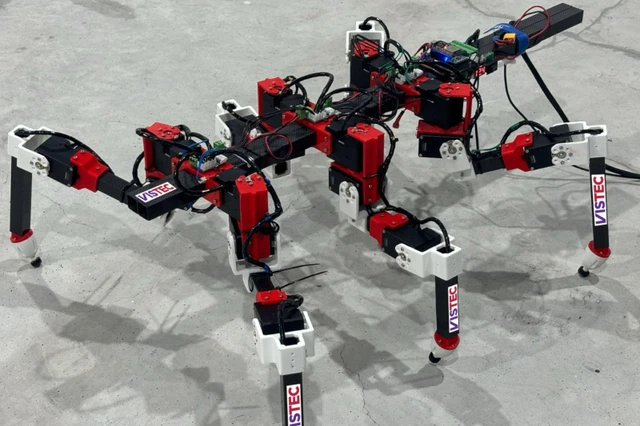
The results were remarkable: a hexapod robot, five times the size of its biological counterpart, required only a brief observation of a stick insect traversing a flat surface to begin its learning process. In less than an hour, the system independently synthesized a gait pattern that allowed the machine to navigate diverse terrains with confidence. Crucially, the robot did not merely mimic movements; it internalized the fundamental principles of locomotion, rendering the model universal.
This versatility was further validated when the system was deployed on robots with differing physical architectures. It became evident that the trained model could adapt to varying morphological parameters, shifting the challenge of motion control from the specifics of a particular device to the implementation of a generalized behavioral algorithm.
The practical implications of this approach extend far beyond the confines of the laboratory. The most promising applications lie in industrial disaster zones and areas struck by natural calamities, where surfaces are inherently uneven and unpredictable. In such environments, systemic resilience is critical. Thanks to the flexibility of the AI, these robots can continue their missions even after a partial loss of functionality—such as the loss of one or more limbs. The system simply recomputes locomotion parameters in real-time to adapt to new physical constraints, making such machines indispensable tools for search-and-rescue operations in extreme conditions.
 Power and Poise: The Xiaomi Pad 9 Pro Max