Space continues to unveil its true nature, transforming what we once perceived as mere points of light into intricate, multi-component architectures. The recent discovery of the asteroid Nysa has presented a profound challenge to contemporary astronomy, marking the first documented instance of a triple-object system within our Solar System. This celestial wanderer possesses more than just an anomalous morphology; it holds the keys to unlocking the formative processes of the inner planets. Analyzing its structure offers a rare window into the system's origins, reaching back four and a half billion years.
First identified in the mid-19th century, Object (44) Nysa remained for decades little more than a spectral pinpoint on the celestial canvas. Even the capabilities of the Hubble Space Telescope were insufficient to fully resolve its internal structure. For years, the prevailing consensus was that Nysa might be a binary system—a common configuration among asteroids and comets—but recent data acquired via the Large Binocular Telescope (LBT) in Arizona and the Very Large Telescope (VLT) in Chile have fundamentally overturned these assumptions.
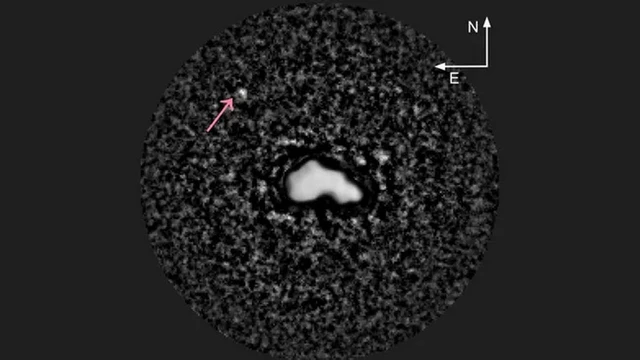
Visualizing the object required the deployment of cutting-edge high-contrast imaging techniques. To mitigate the blurring effects of Earth's atmosphere, researchers utilized adaptive optics systems paired with the Italian SHARK-VIS camera and the SPHERE instrument equipped with the ZIMPOL polarimeter. The primary technical hurdle was the intense luminosity of the main body, which effectively masked the faint signals emanating from its satellites. To overcome this, specialized image-processing algorithms were developed to strip away the brilliant halo surrounding the asteroid, revealing the hidden structural details beneath.
The results of the analysis were sensational: researchers discovered an object 75 kilometers in width, characterized by two deep valleys that effectively divide it into three distinct sections. These "isthmuses" suggest that Nysa is either a contact triple—where three separate bodies are held together by weak gravitational forces—or a singular, highly deformed coherent body. In addition to the primary mass, a micro-moon just 1 kilometer wide (designated as S/2026 (44) 1) was detected, orbiting the central body at a distance of at least 170 kilometers.
The origin of such an anomalous configuration remains a subject of debate, with modern science proposing two primary hypotheses. The first suggests that Nysa is a "contact triad," formed through the gradual convergence of three independent bodies. The second theory is more dramatic: it posits a collision with a massive object, resulting in colossal mantle deformation driven by tidal forces. However, this latter theory faces a significant contradiction—such catastrophic events typically generate entire asteroid families with identical compositions, yet Nysa remains essentially solitary within its class.
The true nature of the object's formation will likely be revealed through an analysis of its satellite's orbit. By tracking the orbital period of the micro-moon, astronomers can calculate the mass and density of the primary body with high precision, allowing them to discard erroneous models.
Beyond its morphology, Nysa is of exceptional interest from a cosmochemical perspective. It is the largest and brightest representative of E-type asteroids, which are characterized by a high albedo due to their concentration of enstatite—a silicate mineral almost entirely devoid of iron. According to established models, such objects formed in close proximity to the Sun. This positions Nysa as a priceless "building block" of the inner planets and a unique relic from the era of Earth's genesis, offering a window into the conditions that prevailed in our solar system billions of years ago.
 The Era of Seven Hundred Falcon Family Launches