The era of feature phones left behind more than mere nostalgia; it bequeathed a vast repository of engineering ingenuity that has now become a subject of digital archaeology. As modern smartphones continue to evolve, access to original hardware from the late nineties grows increasingly elusive, transforming these legacy devices into rare artifacts. The advent of an open-source emulator for the DCT3 platform brings this experience directly into the browser, repositioning legendary Nokia handsets as subjects for rigorous technical analysis. This project represents a concerted effort to safeguard software heritage through an uncompromising commitment to hardware fidelity.
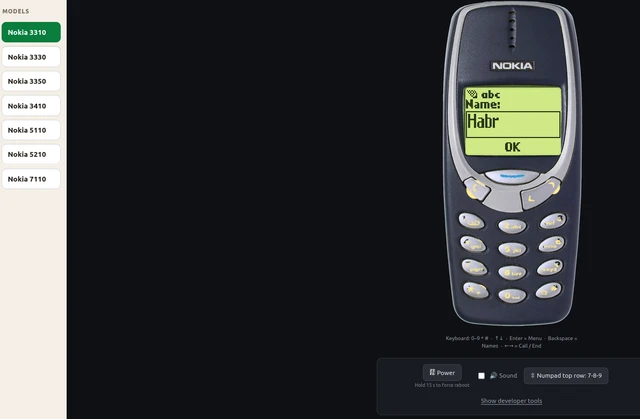
In the contemporary landscape of open-source development, there is a growing movement dedicated to the preservation of our digital heritage. One such ambitious endeavor is the Nokia DCT3 Emulator—an open-source, browser-based tool designed to meticulously replicate the operation of iconic handsets, ranging from the ubiquitous 3310 and 3330 to the more advanced 5210 and 7110. Developed using C and JavaScript and released under the GNU GPL v2.0 license, the project transcends mere aesthetic mimicry; it provides a comprehensive execution environment for original firmware.
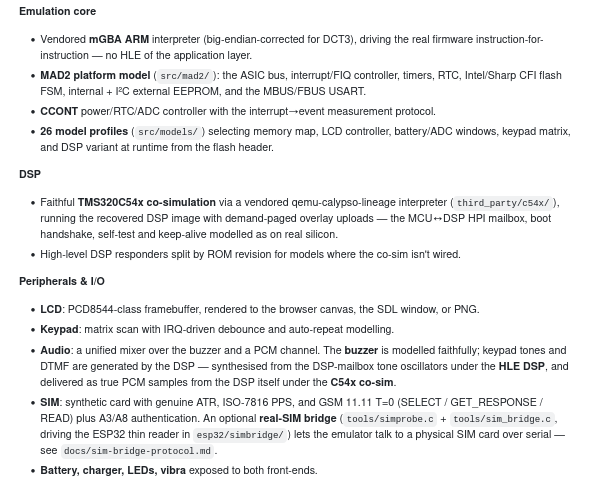
The technical merit of this solution lies in its profound level of abstraction. Rather than opting for a superficial approach—where device behavior is simulated by modifying the firmware—the developers adopted a "silicon-level modeling" strategy. The emulator precisely replicates the MAD2 ASIC platform, the CCONT power controller, and the TMS320C54x Digital Signal Processor (DSP), which historically handled audio processing and system calls.
Beyond the computational core, the system achieves high-fidelity simulation of peripheral hardware: PCD8544 and SED class monochrome LCDs, the physical keypad matrix, SIM card functionality, and internal/external EEPROM modules. This architectural rigor allows users to load authentic device firmware directly in a browser or via a native SDL-based graphical interface, ensuring system behavior identical to that observed on original hardware a quarter-century ago.
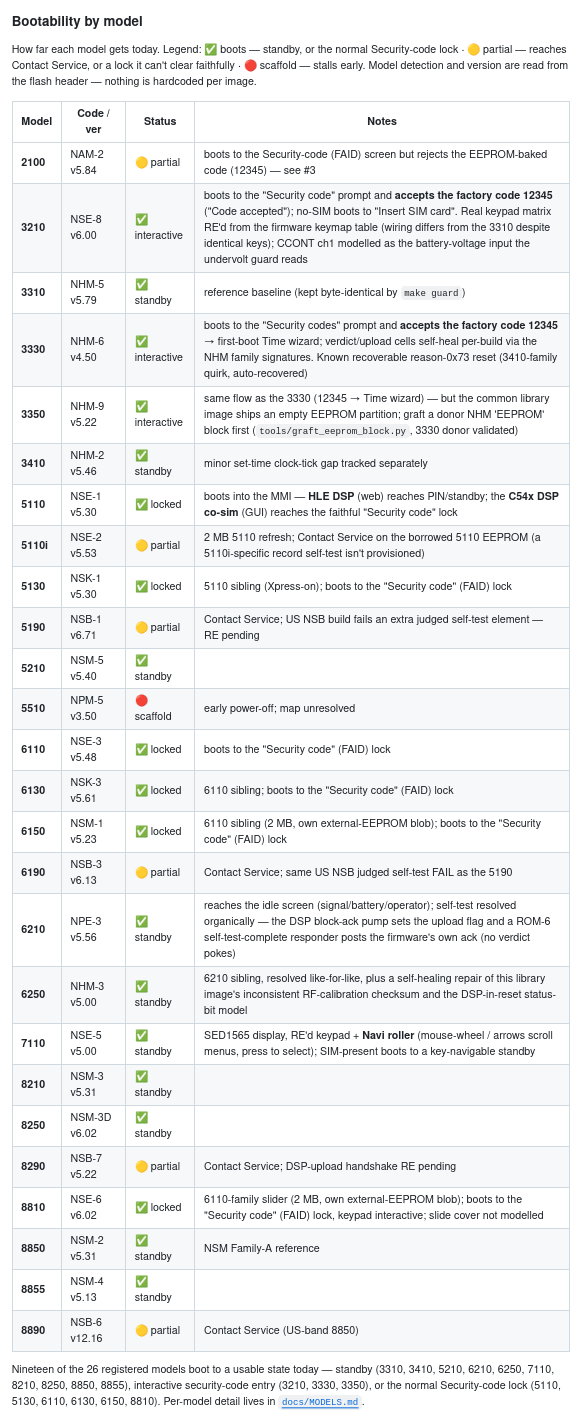
From the perspective of engineering ethics, the project is positioned as a vehicle for historical preservation and educational analysis. In an era where hardware limitations mandated rigorous code optimization, studying the DCT3 architecture offers invaluable insights into how systems operated under extreme memory and processing constraints. By eschewing "shortcuts" or forced self-test results, the emulator ensures that researchers encounter the system in its pristine state, including original boot locks and integrity verification mechanisms.
Ultimately, the Nokia DCT3 Emulator transforms the web browser into a laboratory for studying legacy mobile technologies. It evolves vintage handsets from mere collectibles into active subjects of analysis, allowing a new generation of developers to witness firsthand how the foundations of modern mobile communication were engineered.
 The Evolution of Ultrabooks: Driven by Solid-State Cooling