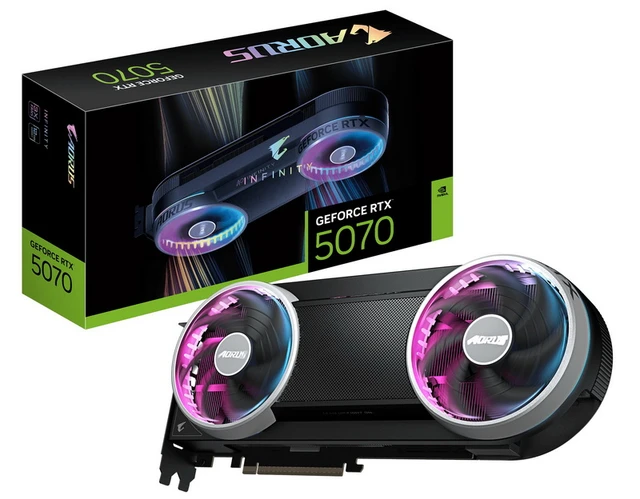
The contemporary GPU landscape is pivoting toward an era defined by ultra-high-speed GDDR7 memory and revamped energy efficiency standards. Against this backdrop, every design choice becomes a strategic tug-of-war between raw, extreme performance and the minimalist visual purity of the chassis. The new Aorus GeForce RTX 5070 Infinity is more than just a hardware update; it is an ambitious attempt to redefine both thermal management principles and the fundamental aesthetics of PC architecture. This card serves as a masterclass in how profound engineering innovation can be leveraged to craft an uncompromising user experience.
At the heart of the new graphics card is a GPU featuring 6,144 CUDA cores, which, in its factory configuration, delivers a significant clock speed boost over reference designs. In Boost mode, the device hits 2,715 MHz, substantially outpacing the base 2,512 MHz of the standard RTX 5070. This performance headroom is further augmented by the transition to the new GDDR7 memory standard. Equipped with a 192-bit bus and a data transfer rate of 28 Gbps per pin, the 12 GB of VRAM provides the necessary bandwidth to handle resource-intensive workloads and modern high-resolution gaming.
The hardware stack is fully aligned with the demands of contemporary computing: the PCIe 5.0 interface ensures maximum data throughput between the GPU and CPU, while the connectivity suite—comprising three DisplayPort 2.1b ports and one HDMI 2.1b port—allows the card to drive up to four monitors, supporting the highest current standards for refresh rates and color fidelity.
Engineers have placed a particular emphasis on thermal management. The Windforce Hyperburst cooling system is anchored by two massive Hawk fans, but the standout feature is the Dual Flow-Through concept. Unlike traditional systems where the PCB acts as an airflow obstruction, this design allows air to flow freely through the radiator fins and specialized cavities in the backplate, radically optimizing heat dissipation from critical components. For extreme operating conditions, a discreet, compact fan is integrated into the center of the system, activating only during peak GPU loads. Heat transfer efficiency is further enhanced by a copper contact plate, high-performance heat pipes, and a composite metal thermal interface material.
With dimensions of 309 × 132 × 55 mm, the card is a commanding presence in any build, but its physical execution reveals one of Gigabyte's boldest design choices. The 12V-2×6 power connector is relocated to the lower rear of the card and concealed beneath a magnetic cover. This decision is driven by a commitment to visual minimalism; while it limits the cable's bend radius, the configuration significantly declutters the interior of the chassis. For compatibility with legacy power supplies, a dual 8-pin adapter is included in the box.
While pricing details and the exact global release date for the Aorus GeForce RTX 5070 Infinity remain undisclosed, the emergence of such a model underscores a growing trend toward the convergence of high-end "techno-art" and uncompromising thermal engineering.
 The Pinnacle of Clarity: AOC's New 5K Monitor