Global supply chain volatility and the semiconductor shortage are fundamentally reshaping the consumer electronics landscape. The era of ultra-budget devices is rapidly drawing to a close, superseded by a strategic pivot toward increasing the average selling price of hardware. In the United States, this trend has manifested in more radical terms, effectively eradicating the entry-level market segment. Current dynamics signal a systemic shift toward the "premiumization" of even the most fundamental connectivity needs.
The modern mobile device market has fallen victim to geopolitical volatility and a chronic shortage of electronic components. A scenario where the cost of chips and logistics outpaces purchasing power in the entry-level segment has led to dramatic consequences for the most affordable smartphones. In the US, sales of devices priced under $100 have plummeted by 64% year-over-year, effectively erasing this market tier.
While the overall decline of the US smartphone market in the second quarter was a modest 5%, and sales for industry leaders—Apple, Google, Motorola, and Samsung—dipped by only 4%, this relative stability masks a profound structural crisis within the ultra-budget sector. Manufacturers are faced with a stark choice: raise prices to maintain profit margins amidst rising component costs or cease production of low-end models entirely.
The transformation of the prepaid market has played a pivotal role. Previously, carriers offered ultra-affordable devices as an "entry point" for new users, but this strategy is no longer viable. The price gap between generic budget handsets and quality offerings from Samsung or Motorola has narrowed to the point where both consumers and operators favor established brands. Consequently, the market share of these companies' budget lines is growing, despite a general decline in segment activity.
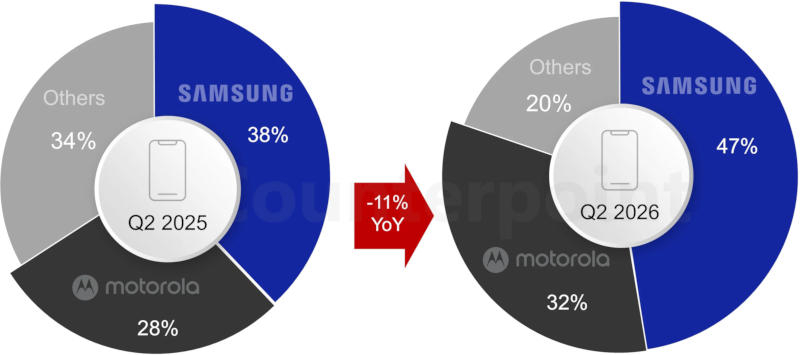
Market dynamics reveal a clear upward migration of users across the pricing spectrum. The $200–$300 segment saw exponential growth during the reporting period, tripling its figures compared to last year. This shift is less a result of increased consumer wealth and more a consequence of mid-range models—such as the Motorola Moto G series—simply becoming more expensive and migrating into a higher category.
This trend toward a rising Average Selling Price (ASP) is becoming the industry's dominant narrative. We are seeing a systemic price hike for new flagships and near-flagships: for instance, Google Pixel 11 devices have increased by $100 across all configurations compared to their predecessors. Samsung has followed suit with the updated Galaxy Z Fold8 Ultra. Apple is expected to maintain this trajectory with the launch of the iPhone 18 lineup, further cementing the trend toward more expensive mobile technology.
Consequently, the market is evolving toward a state where the "cheap smartphone" ceases to exist as a distinct category. The technological barrier to entry is rising, and devices are becoming more durable and expensive—transforming the smartphone from a disposable commodity into a significant investment, even for the mass-market consumer.
 The Evolution of Apple's Augmented Reality Ecosystem