In recent years, the handheld gaming market has evolved from a marginal niche into a primary technological battleground. For an extended period, Valve maintained an uncontested lead, establishing the gold standard for bridging the gap between expansive PC libraries and portable form factors. However, recent market volatility has exposed a critical threshold of consumer price sensitivity toward hardware costs. The precipitous decline in Steam Deck demand underscores that even cult status cannot insulate a product from an insurmountable price ceiling.
Since its debut in 2022, the Steam Deck has been positioned not merely as a handheld console, but as the vanguard of a new era in accessible portable gaming. For years, the device maintained a dominant presence atop Valve's sales charts; any temporary dip outside the top ten was viewed as a mere anomaly. However, current dynamics suggest a systemic downturn: following price adjustments in May, the device's popularity has begun to plummet.
Data from the Steam platform reveals a concerning trajectory. While the console spent much of 2025 firmly entrenched in the top five bestsellers, it crashed to 14th place by July. Although it later clawed back to 12th, the overall outlook remains bleak.
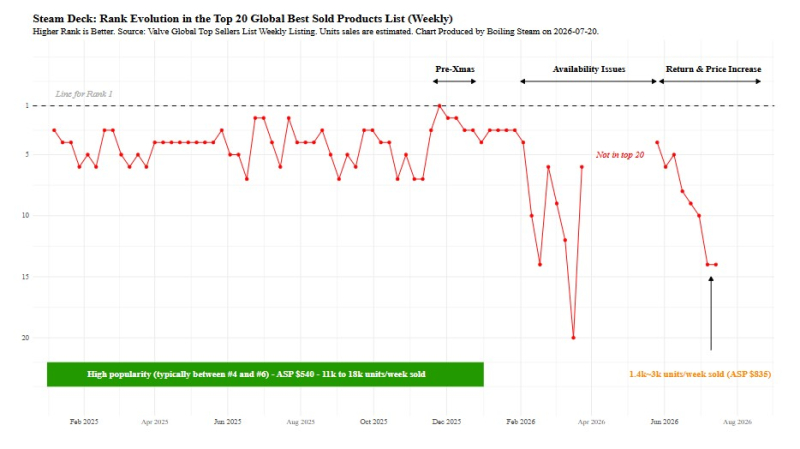
The quantitative data paints an even more dramatic picture. According to independent estimates from Boiling Steam, weekly sales volume may have contracted by approximately 80% compared to last year's benchmarks. Where Valve previously shipped between 11,000 and 18,000 units per week, current figures fluctuate between 1,400 and 3,000 devices. Despite the margin of error in these estimates, the overarching trend is undeniable: the device's growth momentum has stalled significantly. While roughly 4 million Steam Decks have been sold over its three-year lifespan, the product has now entered a phase of stagnation.
The primary catalyst for this decline is the pricing disparity. The historical price range of $400 to $649 struck an ideal balance between value proposition and affordability. The shift toward new price points—ranging from $789 to $949, driven by global shortages in RAM and NAND flash memory—has effectively eroded consumer appetite.
In this higher price bracket, the Steam Deck loses its status as a singular offering and enters a zone of fierce competition. A buyer willing to spend nearly a thousand dollars will naturally evaluate alternatives such as the ASUS ROG Ally, Lenovo Legion Go, or MSI Claw. These devices often boast more current technical specifications, rendering the current cost of the Steam Deck unjustifiable for the discerning, pragmatic user.
The situation is further exacerbated by supply chain volatility. Valve has repeatedly cited periodic shortages across various regions. Even after sales resumed in late May, intermittent stockouts occurred in North America, signaling deep-seated issues with logistics and production capacity.
For the industry, this slump may be a harbinger of the first-generation Steam Deck's sunset. Under normal circumstances, such dynamics would herald the imminent announcement of a Steam Deck 2. However, the current climate—marked by a memory market crisis and the rising cost of semiconductors—creates a strategic conundrum. To ensure the profitability of a next-generation device, Valve may be forced to set a price point that is even more prohibitive for the mass market, potentially transforming the handheld PC from an accessible gadget into a luxury premium accessory.

 Energy Autonomy: The Extreme Edition