The generative AI industry has entered a phase of profound structural contradiction. While the cost of access for the end user is plummeting, the overhead of building and sustaining the necessary infrastructure continues to climb. A precarious divergence has emerged: the cost of producing a single token is no longer falling fast enough to outpace the declining market price of the product. Consequently, the entire sector is now betting on explosive consumption growth, hoping that sheer scale will offset a systemic deficit in profitability.
The contemporary AI landscape is governed by the cold logic of mathematics, where the primary commodity has become the token—the smallest unit of information processing. According to the Silicon Data LLM index, the cost of these units is plummeting in near real-time, making AI-as-a-Service (AIaaS) more accessible and attractive. In a classic technological cycle, this is viewed as a bullish signal: falling prices pave the way for mass adoption. However, beneath this surface-level accessibility lies a troubling trend: the cost of "raw materials" and production tools is climbing, pushing profit margins toward zero.
The core of the problem is that compute costs are not following the downward trajectory of service pricing. The semiconductor market is grappling with a structural shortage that is driving prices upward. Industry titans like Nvidia are facing mounting client expectations regarding server costs, which could surge by more than 15% over the coming year. Simultaneously, Samsung and SK Hynix are reporting critical shortages of the high-bandwidth memory essential for LLM operations, leading to spiked contract prices and capacity reservations spanning several years.
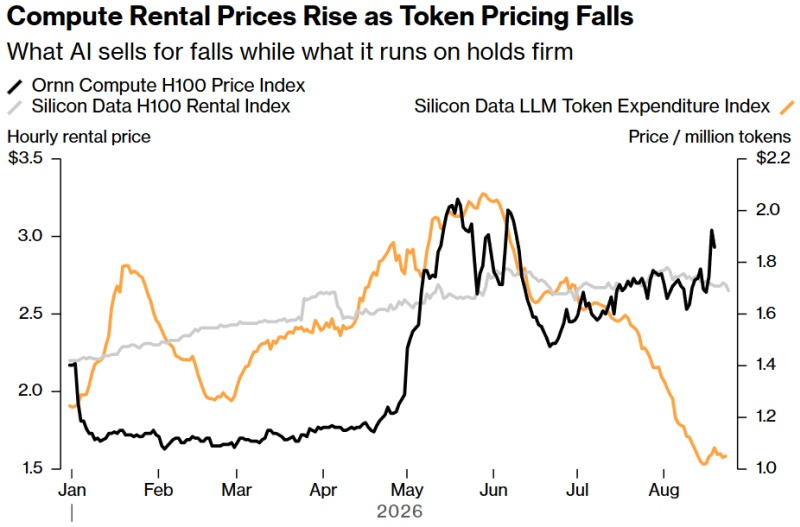
The industry finds itself caught in a paradox: to remain competitive, AI providers are forced to slash prices for users, yet maintaining the underlying infrastructure requires increasingly expensive and scarce hardware. Optimists bet on the economy of scale. Indeed, AI penetration within the US business environment has reached 60%, and revenue for the largest hyperscalers from cloud services is showing impressive growth, exceeding last year's figures by 40%. However, this growth is highly uneven. While some corporations spend up to $7,400 per employee per month on AI, the median spend for mid-sized businesses remains symbolic—roughly $12.
An even more formidable challenge is the absence of a clear financial return. An analysis of financial reports from major US financial firms paints a sobering picture: despite the ubiquitous mention of AI in reporting and significant capital expenditure, only a handful have demonstrated a real monetary equivalent in profit. Companies are pouring billions into automation tools, yet these investments have yet to translate into a tangible increase in net income or a radical reduction in operational expenses.
Capital markets are beginning to exercise caution. While Goldman Sachs analysts note that earnings-per-share (EPS) forecasts remain stable for now, valuation multiples are starting to contract. Investors are realizing that the infinite growth of revenue for Nvidia and other hardware providers may decelerate if the end-consumers of AI cannot find a way to monetize the efficiency gains.
Ultimately, the economics of artificial intelligence are caught in a three-way vice: the rapid devaluation of the product itself, the escalating cost of the hardware base, and a lack of proven ROI for the corporate sector. The only viable exit is a scenario of hyper-growth in consumption, which must offset falling margins through sheer volume. If demand fails to be explosive, the current AI development model may face a severe crisis of sustainability.

 iPhone 17: Dominating the Global Market