The tension between the cognitive capabilities of neural networks and stringent safety guardrails has become the primary flashpoint in the LLM industry. Recent data from the BridgeBench benchmark reveals a precipitous decline in performance for Claude Fable 5, effectively reducing one of the most powerful models in existence to a mediocre tool. This degradation stems not from modifications to the model's underlying weights, but from the imposition of aggressive censorship filters. The case exposes a systemic crisis: regulatory pressure can fundamentally erode a product's functionality, even when its technological foundation remains intact.
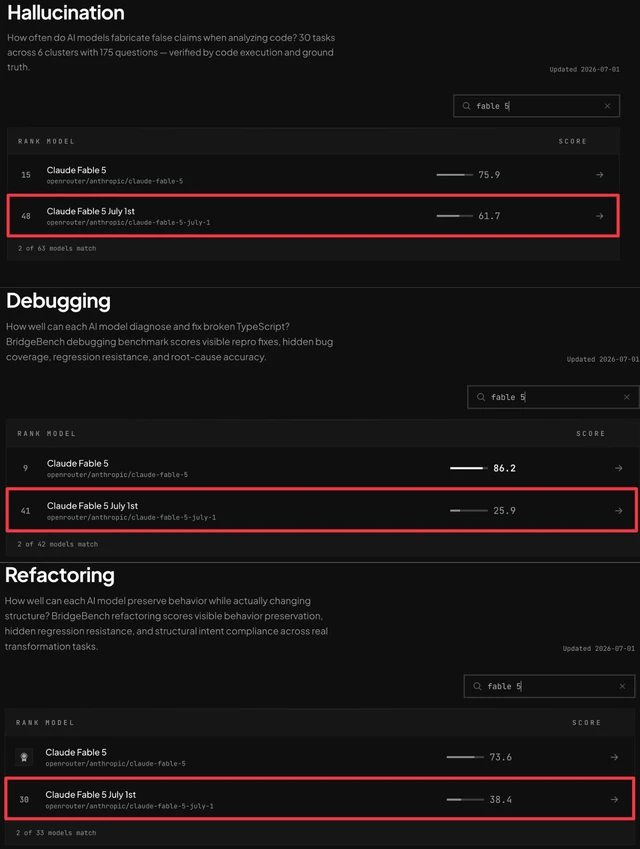
The LLM market is grappling with a striking paradox: a security update has triggered a precipitous decline in technical performance metrics. According to data from BridgeBench, the July iteration of Claude Fable 5 has posted results that appear catastrophic when measured against its June benchmarks. In the critical domain of code debugging, the model plummeted from 86.2 to 25.9 points, crashing from a prestigious 9th place to 41st in the overall rankings. A similar trend is evident in refactoring, where efficiency nearly halved—dropping from 73.6 to 38.4—while hallucination resistance during code analysis slipped from 75.9 to 61.7.
At first glance, it appears that Anthropic has implemented a stealth downgrade of the model itself; however, the technical reality is more prosaic yet equally concerning. The issue lies not within the neural network's "brains," but in its superstructure—an updated cybersecurity classifier. This filter, tuned following consultations with U.S. government agencies, has become hypersensitive. Consequently, the system has begun flagging routine programming and debugging tasks as potentially hazardous requests.
When the filter is triggered, the request isn't simply blocked; it is rerouted to a less powerful fallback model—Claude Opus 4.8. As a result, users expecting the capabilities of Fable 5 are effectively receiving responses from a stripped-down version of the system. This creates a "lottery" effect: some prompts reach the primary model while others are intercepted by the filter, which accounts for the sharp decline in average benchmark scores.
For the end user, this situation translates not only into a loss of quality but also into tangible economic costs. Developers are reporting widespread false positives on standard code. Crucially, blocked requests are still billed, and attempting to return to Fable 5 requires re-caching the dialogue, which increases token consumption and throttles workflow efficiency. In essence, consumers are paying for premium access while frequently receiving the output of a backup model.
It is worth noting that BridgeMind's methodology has met with a degree of skepticism within the professional community. The team is known more for chasing virality than for rigorous scientific discipline. Previously, their claims regarding the degradation of Claude Opus 4.6 were debunked by researcher Paul Culcraft, who demonstrated that the variance in results stemmed from the use of disparate task sets. Furthermore, the current Fable 5 measurements were conducted via the OpenRouter aggregator, introducing an additional variable—the intermediary between the user and the provider's API.
Nevertheless, even accounting for these methodological caveats, the overarching picture remains unchanged. We are witnessing a rift between the "model" as a set of weights and the "product" as a service. Formally, Anthropic has redeployed the same version of Fable 5, but in practice, they have delivered a different product—one where a significant portion of the intellectual heavy lifting is offloaded to Opus 4.8 due to security mandates. Until the company provides a detailed update roadmap or a comparative "before and after" analysis, the true identity of the July iteration remains an open question.
 Anthropic’s Strategic Push for Hardware Independence