The quest to return humanity to the lunar surface has evolved into one of the most formidable engineering undertakings of the modern era—a mission where the margin for error is non-existent and any single failure could prove catastrophic. At the Kennedy Space Center, assembly is underway for the SLS rocket destined for the Artemis III mission: a technological titan engineered to shatter the bonds of Earth's gravity. Yet, the upcoming launch presents a striking paradox: the most powerful launch vehicle in American history will be deployed primarily for near-Earth maneuvers. This strategic decision underscores NASA’s uncompromising commitment to crew safety before the final leap toward Earth's natural satellite.
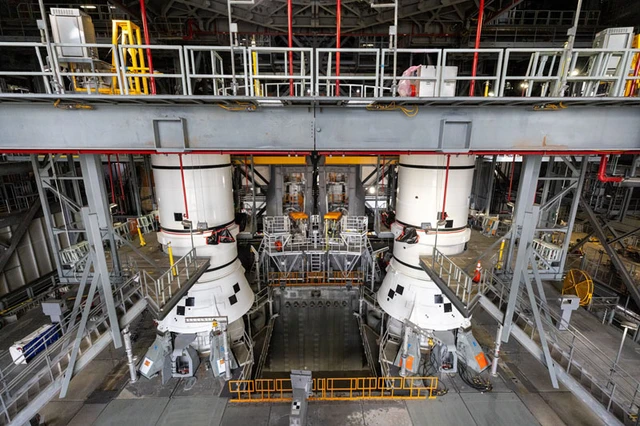
Preparations for the Artemis III mission have reached a pivotal milestone: the vertical assembly of the Space Launch System (SLS). In July, technicians secured the aft sections of the solid rocket boosters to the mobile launcher. These components serve as the structural foundation of the entire vehicle, distributing the colossal mass of the rocket and spacecraft across the launch pad during liftoff.
The technical specifications of these boosters are formidable. Each consists of five segments, standing 54 meters tall with a diameter of 3.7 meters. Fully loaded, a single booster weighs approximately 726 tons and generates up to 16 MN of thrust. Together, the two boosters deliver 32 MN, providing over 75% of the rocket's total liftoff power during the first two minutes of flight. Their operation is limited to 126 seconds, after which they separate, handing control over to the core stage.
Simultaneously, work continues on the rocket's primary structure. The liquid hydrogen and oxygen tanks, the intertank, and the forward skirt have already been integrated into the assembly. Particular attention is being paid to the propulsion system: four RS-25 engines are being installed on the stage. These powerplants represent a piece of technological heritage from the Space Shuttle program; running on cryogenic propellants, they provide approximately 8.9 MN of thrust, allowing the rocket to maintain acceleration after the side boosters are jettisoned.
Alongside the launch vehicle, the Orion spacecraft is undergoing final refinements. A primary focus has been the upgrade of the Command Module's heat shield, which comprises 186 individual blocks of Avcoat ablative material. The manufacturing process for these blocks was overhauled after structural anomalies were detected during the Artemis I mission. Enhancing the material's homogeneity and permeability is critical to ensuring the crew can safely penetrate the dense layers of the atmosphere at hypersonic speeds. The final step will be the mating of the capsule with the European Service Module, which has already successfully completed a series of acoustic tests.
Yet, beneath this display of technical prowess lies a strategic nuance: despite its capacity to reach the Moon, this specific rocket configuration will remain in Low Earth Orbit (LEO) for this particular mission. From an economic standpoint, it appears to be an extraordinarily wasteful operation—deploying one of the most expensive rockets in history for tasks that could theoretically be handled by lighter launch vehicles.
However, this strategy is dictated by stringent safety requirements. The Artemis III mission will serve as a proving ground for docking Orion with lunar lander demonstrators—specifically Blue Moon and Starship. Conducting these tests in near-Earth space allows NASA to maintain tight control; should complications arise, the crew can be swiftly returned to Earth. In deep space, orbiting the Moon, such an option is virtually non-existent.
A lack of resources for a comprehensive series of uncrewed tests turns every SLS launch into a high-stakes "single chance." The staggering financial investment in this launch is justified by the fact that successful orbital tests are the only guarantee for the safety of the future landing. If everything proceeds according to plan, it will clear the path for the full-scale return of American astronauts to the lunar surface by late 2028.
 A Pragmatic Approach to Lunar Equipment Design