The vision of instantaneous drone delivery is rapidly evolving from a futuristic ambition into a tangible reality for millions. Amazon is aggressively scaling its Prime Air service across hundreds of cities, striving to bring "last-mile" logistics to a state of total automation. However, the transition from sterile testing environments to the unpredictability of urban chaos is exposing critical deficiencies in machine spatial perception. When algorithms fail to distinguish a secure landing zone from a swimming pool or a pond, the actual maturity of current navigation systems is called into serious question.
Amazon's expansion into autonomous delivery is reaching a new scale, with plans to deploy a drone network across 500 U.S. cities. This ambitious move transitions Prime Air from an experimental project into a full-fledged infrastructural asset. However, as the geographic footprint expands, so does the complexity of the scenarios facing its control algorithms—and it is here that the systemic vulnerabilities of the current UAV generation are becoming apparent.
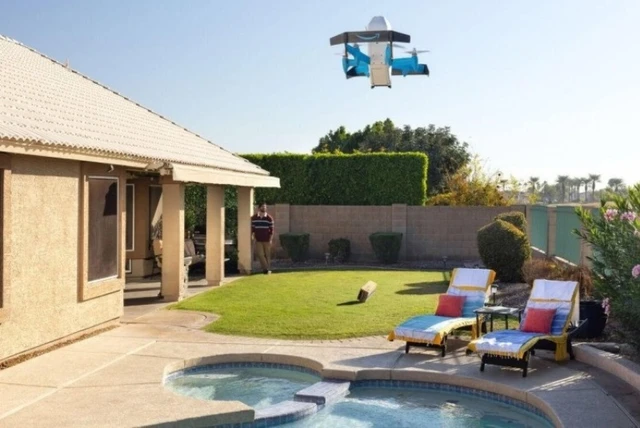
One of the most glaring issues has been the drones' inability to correctly identify drop-off surfaces. Reports have surfaced showing devices mistaking swimming pools and other bodies of water for suitable landing zones. In one instance in Texas, a drone simply hovered over water and dropped a package directly into a customer's pool. In other cases, the issue is purely physical: the powerful downwash from the propellers literally blows the cargo into the water, even when the drop point is correctly identified. There have also been recorded instances where packages, striking the edge of a pool or the ground, ricochet into the water.
These incidents highlight a fundamental flaw in computer vision and semantic spatial analysis. To a navigation system, a flat surface of water can appear identical to smooth concrete or a lawn if the object classification algorithms are not calibrated to recognize the specific properties of liquids or reflective surfaces.
Yet, these "aquatic" failures are merely the tip of the iceberg. The rollout of Prime Air has been marred by more severe technical malfunctions. Last year, Amazon was forced to temporarily suspend operations in the West Valley area of Phoenix following a series of accidents. MK30 drones collided with construction cranes, crashed into residential walls, and even severed internet cables, demonstrating a significant degree of "blindness" when interacting with a dynamic urban environment.
Currently, Amazon's safety protocols are focused on mitigating human injury; before releasing a package, the drone verifies that no people are in the immediate vicinity. While this is a critical function, it overlooks the integrity of the cargo itself. It is evident that for the service to scale effectively, the company must evolve from simple obstacle detection toward a deep, contextual understanding of the surrounding environment.
The situation with Amazon underscores the primary challenge of modern robotics: the gap between a machine's ability to follow a route and its capacity to interpret the physical nature of objects at the destination. Until algorithms can distinguish the mirrored surface of a pool from a safe backyard, last-mile automation will remain a gamble where the stakes are the safety of the order.
 Anthropic’s Strategic Push for Hardware Independence