Today’s global race for AI supremacy is no longer defined solely by algorithmic sophistication; it has become a battle over access to staggering amounts of energy. Traditional data centers are becoming increasingly unwieldy, hampered by their critical dependence on localized power grids. Elon Musk proposes a radical pivot: a transition toward a distributed, modular computing infrastructure. By leveraging Tesla’s existing charging network, routine power points could be transformed into the nodes of a planetary-scale supercomputer.
The modern AI industry is grappling with a fundamental paradox: while the demand for computational power is growing exponentially, the ability to rapidly deploy energy-intensive data centers is stifled by physical constraints and regulatory hurdles. In this climate, the concept of a distributed supercomputing network is not merely ambitious—it is strategically imperative. The vision entails a system where compute nodes are integrated directly into existing energy infrastructure.
At the heart of this architecture lies the Megapod—a modular supercomputer designed as a standalone unit. Essentially, it is a high-tech container capable of being transported to any location and commissioned rapidly. The module envisions a synergistic blend of two distinct computing paradigms: proprietary Tesla AI4 silicon, optimized for specific neural network workloads, and traditional x86-compatible CPUs to ensure general compatibility and process orchestration. This hybrid approach marries the narrow specialization of accelerators with the versatility of conventional CPUs.
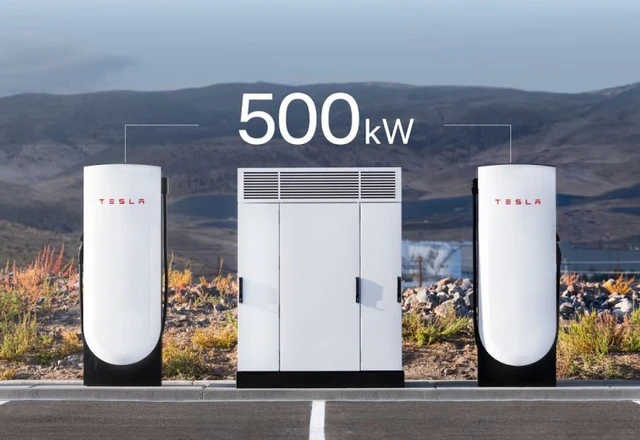
The project's primary strategic advantage is the utilization of the Supercharger network. Tesla’s charging stations already possess high-capacity power feeds capable of sustaining heavy loads, effectively bypassing one of the most significant bottlenecks in data center construction: the need to lay new power cables and negotiate capacity limits with utility providers. By co-locating compute modules with charging stations, e-mobility infrastructure is transformed into the foundation for a global computing cloud, drastically optimizing initial capital expenditures.
However, any distributed system inevitably faces challenges regarding latency and throughput. To prevent network lag from becoming a bottleneck that neutralizes the raw power of these supercomputers, the Starlink ecosystem could be integrated into the architecture. Satellite connectivity would ensure essential node cohesion even in remote regions, creating a seamless data fabric independent of terrestrial ISPs and fiber-optic backbones.
An intriguing point remains the project's nomenclature. The name "Megapod" is already employed by AMD to describe its server systems featuring massive EPYC core counts and Instinct accelerators. In the realm of corporate law, such a collision will inevitably lead to disputes; consequently, Tesla will likely refine the branding of its solution. Nevertheless, the core premise remains unchanged: transforming fragmented energy points into a single intelligent organism where power and computation merge into a unified technological ecosystem.
 The Triumph of 3nm Chip Manufacturing