The modern smartphone experience is defined by fragmented attention—a constant oscillation between dozens of apps that creates a palpable cognitive rift in how we process information. Traditional AI chatbots exacerbate this friction, requiring separate interfaces and reducing simple workflows to a tedious cycle of copying and pasting. Acti, a Singaporean startup, offers a radical departure: embedding the intelligent agent directly into the input layer. This evolution transforms the keyboard from a passive typing tool into a comprehensive command center for managing digital context.
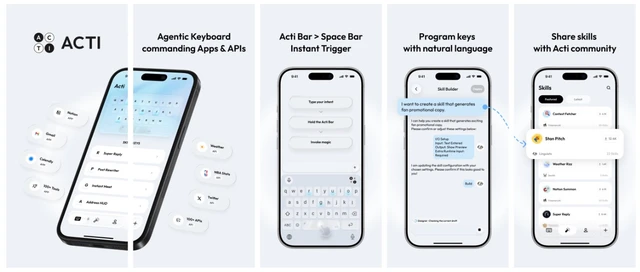
The persistent issue of data fragmentation within mobile operating systems has long served as a critical bottleneck for productivity. When a user is engaged in a conversation via messenger and needs to verify a stock price or locate a restaurant, they are forced to break their current context—switching to a browser or a standalone AI app before navigating back. Acti addresses this friction by embedding agentic intelligence directly into the keyboard for iOS and Android, effectively creating an "intelligent layer" that operates seamlessly across all installed applications.
At the heart of the system lies the concept of "Skills"—customizable commands that transform keys into triggers for complex, multi-step workflows. In its basic configuration, these may be simple actions: a long press on a specific letter for instant translation or the automated insertion of a calendar link. However, the true potential is unlocked through the ability to create custom shortcuts using natural language. Users are not required to write code; they simply describe the desired action in plain text, and the system autonomously transforms that description into a functional algorithm. The efficacy of this approach is already evident: during a two-week early access period, testers developed over a thousand unique skills.
The technological foundation of Acti is built upon the Google Gemini family of models. This stack was selected to maintain a rigorous balance between latency, computational cost, and the quality of multilingual query processing. Gemini serves as the interpretive engine: the model analyzes the textual description of a task and converts it into a sequence of concrete actions within third-party services, ensuring seamless integration.
Particular emphasis has been placed on privacy—a frequent point of contention when implementing AI tools. Acti adopts a local-first paradigm, ensuring that personal context and conversation histories remain on the user's device by default. The application does not aggregate or store personal data, leveraging external computing power only when the user explicitly triggers a function requiring cloud processing.
The Acti ecosystem aims to evolve beyond a mere utility tool. The developers are building a Skills marketplace where users can publish their own creations—ranging from sports event trackers to integrations with prediction markets like Polymarket. Monetization is planned via a subscription model, providing access to more powerful language models and expanded request limits, ultimately transforming the keyboard into a comprehensive intellectual hub for managing one's digital life.
 Anthropic’s Strategic Push for Hardware Independence