Modern AI infrastructure necessitates a fundamental reimagining of data processing principles and component interoperability. Traditional x86 architectures are increasingly becoming the primary bottleneck in scalable systems, throttling the exchange of information between cores and memory. Nvidia’s response to this challenge is manifested in the Vera processor, which pivots away from general-purpose versatility toward massive bandwidth and specialized compute capabilities. This silicon marks a paradigm shift toward deeply integrated ecosystems where the distinction between the central processor and the accelerator effectively vanishes.
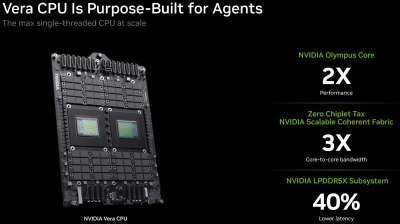
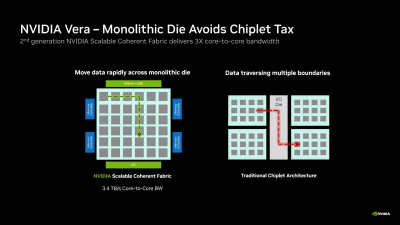
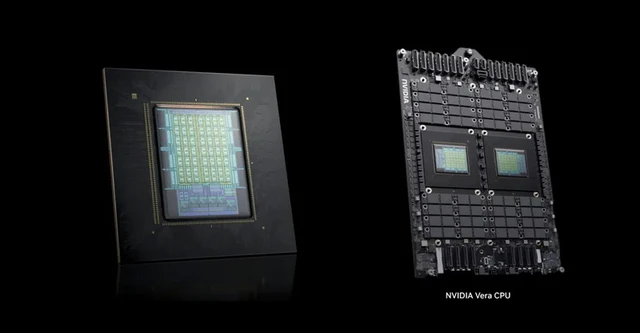
At the heart of this new data center solution lies a monolithic computing die integrating 88 specialized Olympus cores. This configuration delivers 176 hardware threads and leverages a massive 164 MB unified L3 cache, engineered specifically to minimize latency when processing vast datasets in real time.
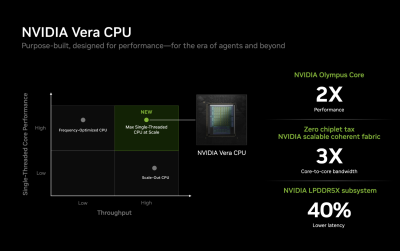
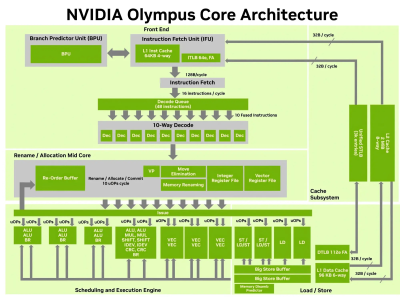
Each Olympus core is a high-performance engine featuring a wide pipeline augmented by a neural branch predictor—a technology that allows the processor to anticipate code execution paths with extreme precision, significantly reducing pipeline stalls. Instruction management efficiency is driven by a 64 KB four-channel L1 cache and an impressive 48-instruction decode queue. The ability to fetch up to 16 instructions per clock cycle, coupled with a ten-channel decoder supporting fused instructions, transforms the core into a powerhouse for data stream processing.
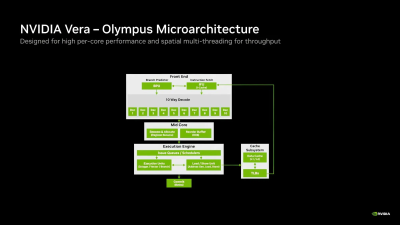
The Olympus technology stack incorporates advanced mechanisms for memory renaming, value prediction, and move elimination. These optimizations are critical for resolving operational dependencies that typically bottleneck the execution of complex algorithms. The execution unit is designed as a versatile engine: it integrates modules for integer and vector computations, floating-point operations, cryptographic functions, and dedicated resources for ultra-fast data movement between memory and registers.
Particular emphasis has been placed on the memory hierarchy. Each core is equipped with a 96 KB six-channel L1 data cache and a 2 MB eight-channel L2 cache. To handle the modern graph-based data structures fundamental to many AI models, hardware prefetching mechanisms have been implemented. This allows the processor to proactively load necessary data from memory—even when stored non-linearly—radically accelerating the processing of complex relationships and pointers.
A defining innovation of Vera is the concept of spatial multithreading. Unlike traditional SMT (Simultaneous Multithreading), where threads often compete for the same resources, the spatial approach allows for flexible allocation of core capacity. This enables the system to prioritize performance-critical threads while relegating background system and management tasks to a secondary stream, effectively eliminating resource contention within a single core.
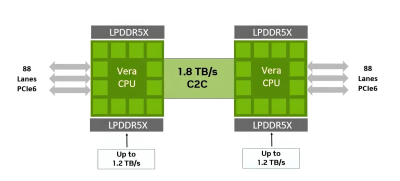
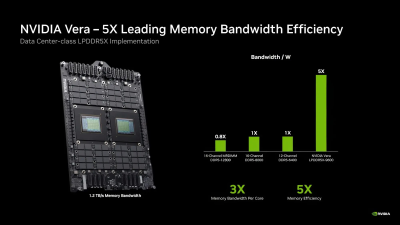
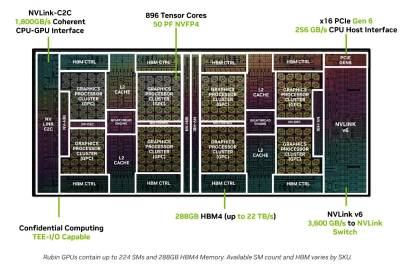
The backbone of the entire system is a second-generation scalable coherent fabric, providing phenomenal inter-core bandwidth of up to 3.4 TB/s. LPDDR5X SOCAMM2 memory ensures data transfer speeds of up to 1.2 TB/s, with supported RAM capacities reaching 1.5 TB per processor. For communication with external devices and other nodes, the system utilizes the NVLink-C2C interface (1.8 TB/s), PCIe 6.0, and the CXL 3.1 protocol. In dual-socket configurations, the system provides 176 PCIe lanes and employs a dual-node NUMA architecture to optimize memory access for each socket.
The practical impact of this engineering philosophy is most evident in the development of autonomous AI agents. According to internal SPEC CPU 2026 benchmarks, Vera delivers performance nearly double that of traditional x86 systems in comparable scenarios. This reinforces the thesis that the future of high-performance computing lies in deep specialization and the aggressive optimization of data paths.
 Energy Autonomy: The Extreme Edition