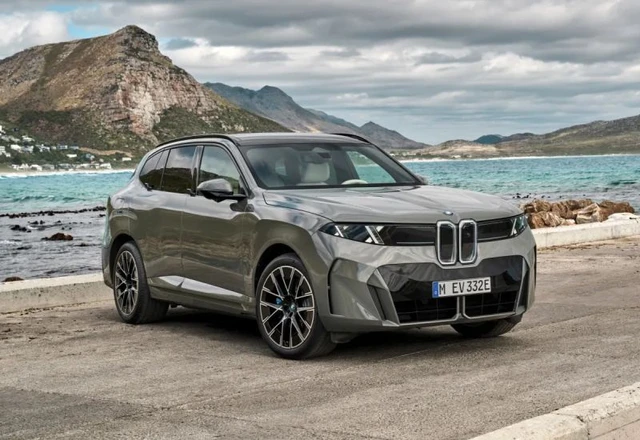
The electric vehicle industry has entered a phase of fierce competition centered on efficiency and real-world range. Against this backdrop, BMW’s Neue Klasse concept transcends its role as a bold design experiment, evolving into a comprehensive technological manifesto. The new iX5 crossover is engineered to blur the lines between traditional premium luxury and the rigorous demands of the digital age. This is a vehicle designed to decisively tackle the primary pain point of modern electric mobility: the psychological barrier of range anxiety.
The Neue Klasse lineup has long been a lightning rod for debate, primarily due to a provocative exterior design that has polarized automotive enthusiasts. Yet, beneath these futuristic contours lies a fundamental architectural reimagining that positions the BMW iX5 as one of the brand's most ambitious undertakings. The vehicle's primary competitive edge is its energy density: the top-tier variant features a massive 144 kWh traction battery, enabling a range of up to 845 kilometers on a single charge. Such figures propel the crossover into the upper echelon of EV autonomy, transforming long-distance interstate travel into a truly seamless experience.
The model's technical bedrock is an 800-volt system. This transition to higher voltage is far more than a mere specification bump; it is a strategic move to drastically reduce thermal losses and accelerate energy transfer. With support for ultra-fast charging stations delivering up to 460 kW, dwell time at the terminal is minimized: replenishing the battery from 10% to 80% takes a mere 23 minutes. This effectively bridges the gap between EV ownership and the familiarity of a traditional refueling stop.
The performance metrics of the iX5 60 xDrive reinforce the brand's sporting DNA. A dual-motor powertrain delivering a combined 578 hp ensures robust all-wheel-drive capability and a 0-100 km/h sprint in 4.6 seconds. Meanwhile, the top speed is electronically capped at 210 km/h. When contrasted with the internal combustion engine (ICE) versions of the X5, which can reach 250 km/h, a clear shift in engineering priorities emerges: in the electric iteration, the focus has migrated from absolute top speed toward efficiency and energy conservation.
Notably, BMW is avoiding a mono-strategy centered solely on lithium-ion batteries. The family includes hybrid modifications as well as a hydrogen-powered variant. This diversified approach allows the company to mitigate risk and provide tailored solutions for varying infrastructure levels and consumer habits.
Inside, the iX5 embodies an ethos of minimalism and deep digital integration. The interior follows the Neue Klasse design language, defined by austere lines and high-tech surfaces. The centerpiece is "Panoramic Vision"—a sweeping display that spans the boundary between the dashboard and the windshield. This system, paired with a 3D projection interface, transforms the windshield into a comprehensive information hub. While the passenger screen and projection remain optional, the massive trapezoidal display on the center console comes standard, setting the tone for the entire digital user experience.
To appeal to a broader market segment, an entry-level version is available with a 141 kWh battery, offering a range of 750 km according to the WLTP cycle. Regarding the go-to-market strategy, BMW is taking a phased approach: updated ICE X5 models will arrive in late November of this year, while the electric and hybrid iX5 variants are slated for release in early 2027. Production will be centered at the company's US facility, underscoring the global ambition of this new platform's expansion.
 The Evolution of Solid-State Batteries: From Smartphones to Electric Vehicles