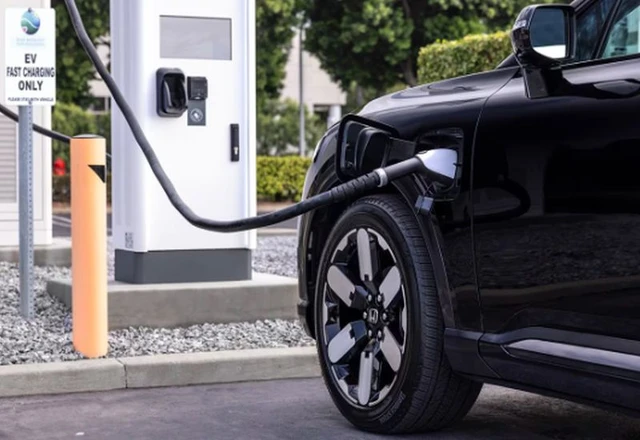
The global energy transition has hit a paradox: while demand for electric vehicles plateaus, the infrastructure powering artificial intelligence is demanding an unprecedented surge in energy. U.S. manufacturing capacities, largely scaled to meet the mandates of the "green" agenda, are now being forced to pivot in search of new growth drivers. Honda’s decision to reorient its battery production toward stationary energy storage systems serves as a landmark symptom of this structural shift. Automotive titans are effectively evolving into providers of the foundational infrastructure essential to the digital economy.
The ambitious drive to localize traction battery production in the U.S., catalyzed by the Biden administration, has collided with a sobering market reality. The anticipated electric vehicle (EV) boom has given way to a period of cooling, leaving manufacturers with a stark choice: mothball expensive facilities or pivot toward alternative markets. In response, Honda has made a strategic bet on one of the fastest-growing segments of the modern economy—the data center infrastructure powering artificial intelligence.
The requirements of modern data centers now extend far beyond basic uninterruptible power supplies (UPS). As the industry shifts toward renewable energy sources, such as wind and solar, it faces the inherent challenge of intermittency. Solar panels and wind turbines generate power inconsistently, yet server farms demand a stable, 24/7 current. This is where large-capacity stationary Energy Storage Systems (ESS) come into play, acting as massive buffers that accumulate surplus energy during peak generation and feed it back into the grid during deficits.
Honda’s operations in Ohio serve as a textbook example of this industrial pivot. A joint venture with LG Energy Solution established in 2022, the facility was originally designed to produce lithium-ion batteries for electric cars. However, by the time construction is slated for completion in 2025, the U.S. EV market has seen an unexpected slump in demand. This forced Honda to overhaul its roadmap, leading to the cancellation of three planned EV models, including one from its premium Acura brand.
To regain strategic control, Honda acquired LG Energy Solution’s stake in the joint venture for $2.5 billion. The Ohio plant's strategy is now split into two primary vectors. First, starting in 2028, the facility will produce batteries for hybrid vehicles, enabling Honda to launch 15 new models by fiscal year 2029. This is a critical move; the company currently relies on battery supplies from its chief rival, Toyota. Transitioning to in-house production will allow for significant cost optimization. Second, the plant will serve as a hub for manufacturing the aforementioned stationary energy storage systems for the American IT infrastructure.
Honda is not alone in this strategic shift; General Motors and Ford have already begun repurposing their excess capacity. GM has not only pivoted its Tennessee plant to meet data center needs but is also betting on a technological breakthrough in Michigan. By 2028, the company plans to master the production of sodium-ion batteries. Despite having a lower energy density than their lithium-ion counterparts, sodium-ion batteries offer critical advantages: they are cheaper, eliminate dependence on scarce lithium, and exhibit far greater stability under extreme temperatures—making them ideal for stationary industrial systems.
Ford, for its part, has established a dedicated subsidiary to target the data center market, utilizing capacity at its Kentucky plant. Notably, this enterprise was also originally a joint venture with South Korea's SK On, which eventually exited the project due to the decline in automotive battery demand.
Despite the optimism of these manufacturers, the scale of overproduction remains staggering. According to S&P Global Mobility, current demand for EV batteries accounts for only about 30% of total global production. Experts believe this gap will persist well into the next decade.
While the stationary energy storage market is indeed expanding—recording a 28% growth last year with demand potentially reaching 735 GWh by 2033—the numbers tell a sobering story. When compared to the total annual production of "automotive" batteries, which stands at approximately 4,480 GWh, it becomes evident that even the rapid ascent of AI and data centers cannot fully absorb the surpluses created during the rush toward transport electrification. Nevertheless, for giants like Honda, this pivot is the only viable path to maintaining industrial relevance in an era of technological turbulence.
 The Evolution of the Apple Home Ecosystem