The global race to develop humanoid robots has reached a critical juncture where spectacle collides with stark reality. Grappling with a demographic crisis and a rapidly aging population, China views these machines as the sole lifeline for its industrial sector. Yet, the chasm between choreographed demonstrations and actual factory-floor utility has proven to be catastrophic. The current state of affairs exposes a fundamental tension between technological ambition and economic viability.
For decades, China's economic miracle was fueled by a vast reservoir of affordable and efficient labor. Today, however, the nation faces an unprecedented crisis: for the first time in a century, birth rates have fallen below mortality rates, and the population is aging rapidly. In this paradigm, humanoid robots were envisioned not merely as a technological milestone, but as a strategic imperative for economic survival—tools capable of seamless integration into the existing industrial ecosystem.
The underlying logic behind anthropomorphic machines was the utilization of a "human-centric interface." The premise was that a robot mimicking human morphology could operate machinery, levers, and equipment originally designed for the human hand, thereby obviating the need for a wholesale overhaul of factory infrastructure to accommodate automation. In practice, however, this approach has collided with an insurmountable barrier of efficiency.
Attempts to operationalize this vision have proven prohibitively expensive. At a training center in Liuzhou, equipped with approximately $18 million in hardware from UBTech, a system based on imitation learning was deployed. Specially trained instructors, outfitted with motion-capture sensors, demonstrated industrial operations to the robots, transmitting movement data via haptic feedback. The objective was to build a "skills library" that could then be marketed to industrial enterprises as a turnkey product.
The results of this experiment have been bleak. It emerged that even the most rudimentary manipulations require between 50 and 300 iterations before the action becomes stable. The cost of such training is so exorbitant that any prospect of a return on investment vanishes. Consequently, these investments have become a capital-intensive sinkhole, where the technological process lacks a coherent roadmap for profitability.
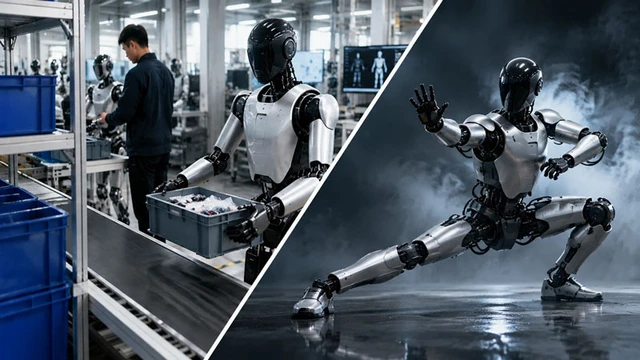
The paradox is that while China has become the undisputed leader in the production of humanoid robots, these machines exhibit a peculiar selectivity in their learning. They effortlessly master complex dance routines and flashy kung fu maneuvers—performances that look flawless during press demonstrations but prove useless in operational environments, whether on a factory floor, in a kitchen, or on a battlefield.
This situation mirrors broader trends within the Chinese tech sector, specifically in photovoltaics and electric vehicles, where the pace of scaling has far outstripped actual utility and market demand. It appears that state-driven planning and the rush for technological primacy have created a scenario where the tools of development arrived long before the understanding of how to manage them effectively. The result is an industry that has produced sophisticated novelties capable of fighting like Bruce Lee, yet incapable of replacing a single worker at a machine.
 Nvidia’s Technological Pragmatism in the Open-Model Race