The contemporary wearables market has long since evolved beyond the realm of purely pragmatic innovation. Today, tech gadgets are increasingly transforming into markers of social prestige, where raw functionality takes a backseat to aesthetic representation. Caviar’s new Odyssey collection embodies this trend in its most absolute form: here, the high-tech device serves as little more than a canvas for fine jewelry and unapologetic elitism.
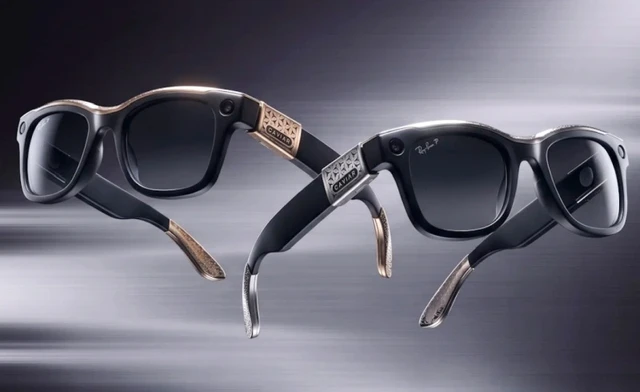
The essence of the new Odyssey concept lies in a sophisticated reimagining of classical motifs, blending iconic design with literary heritage. At its core are the Ray-Ban Wayfarer II smart glasses—already a cultural touchstone in the world of optics. However, Caviar has transformed them from a piece of consumer electronics into a collector's objet d'art, drawing inspiration from the epic works of Homer.
The collection's visual identity diverges into two distinct iterations. The first emphasizes the dazzling brilliance of 24-karat gold, which adorns the decorative plates of the chassis. The second version, Odyssey Silver, utilizes sterling silver accents. Both modifications are built upon the austere black Wayfarer frame, which serves as a neutral canvas for the artisans' craftsmanship; here, the metal is not merely applied but forged and engraved with intricate Greek motifs. The final touch consists of black enamel star details integrated into the temples.
Particular attention has been paid to the psychology of exclusivity. Production for each model is strictly limited to 24 units—a number mirroring the books of the Odyssey. This approach elevates the gadget from a mass-produced product to a rare asset. The philosophy of total transformation extends to the accessories as well: the standard charging case has been entirely wrapped in black crocodile leather, definitively shifting the device from the category of "electronics" into the realm of "high luxury."
From a technical standpoint, the internal architecture remains untouched. Beneath the layers of precious metals lies the standard hardware of the Ray-Ban Wayfarer II. The user retains full access to all the capabilities of modern wearable tech: an integrated camera for instant content capture, open-ear speakers for audio streaming, and integration with an AI-powered voice assistant. The processors, sensors, and battery are identical to those found in the mass-market versions of the device.
However, this creates a fundamental tension between aesthetics and ergonomics. In the wearables segment, weight is a critical parameter of comfort that directly impacts daily usability. The addition of substantial metallic elements inevitably shifts the balance of the frame, potentially creating noticeable strain during prolonged wear. Nevertheless, in the philosophy of hyper-luxury, physical discomfort becomes secondary to visual dominance and the status of the owner.
The cost of such stylistic investment is steep: the gold Odyssey version is priced at $6,130, while the silver iteration reaches $6,840. This underscores the collection's central thesis: technology here serves merely as a vehicle for the demonstration of luxury, transforming an everyday communication tool into an exquisite piece of jewelry.
 The Evolution of Apple's Augmented Reality Ecosystem