The promise of full autonomy has long been the bedrock of Tesla’s market valuation and brand identity. However, the disconnect between software ambitions and hardware capabilities is evolving into an insurmountable chasm. Recent updates underscore a sobering reality: legacy computing systems can no longer sustain the cognitive load required by modern neural networks. This creates a critical tension between corporate narrative and the uncompromising physics of semiconductors.
Tesla’s journey toward autonomy was launched by a bold assertion from Elon Musk in 2016: every vehicle rolling off the assembly line would possess the capacity for full autonomous driving, achievable solely through over-the-air software updates. This vision rested on the conviction that onboard computing power would evolve sufficiently to support advancing algorithms. However, years later, it has become evident that Moore’s Law is failing to keep pace with the skyrocketing requirements of contemporary neural networks—particularly with the shift toward End-to-End architecture, where vehicle control is entrusted entirely to deep learning models.
Today, this illusion has collided with the hard physical limitations of third-generation hardware (HW3). While the newer HW4 systems boast significantly higher memory bandwidth, their predecessors are constrained by a modest 8 GB of RAM and throughput that lags far behind modern standards. Even the release of FSD v14 Lite—an optimized version specifically engineered for lower-spec systems—has failed to resolve the fundamental issue: computational starvation is triggering critical component overheating.
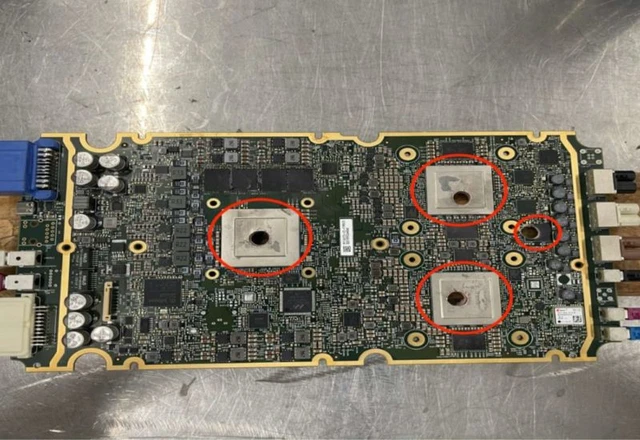
This technical crisis manifests in the most perilous of scenarios: the triggering of thermal protection. When sensors detect component temperatures exceeding 90 degrees Celsius, the system forcibly enters a service mode. At this juncture, all electronic driver assistants are deactivated, and the driver is notified to take immediate manual control. System functionality cannot be restored until the processor has completely cooled down, effectively transforming a high-tech vehicle into a conventional car at the worst possible moment.
Furthermore, the performance degradation of HW3 directly impacts road safety. Users have reported instances of "phantom braking" and perceptible lags in system response when accelerating or resuming motion. From a technical standpoint, this points to data processing latency; the computer simply cannot process the incoming stream of visual information in real-time, creating dangerous pauses in the AI's decision-making cycle.
The situation is compounded by the fact that Tesla has found itself in a strategic trap. Admitting the inadequacy of HW3 essentially necessitates a mass hardware migration to HW4 for millions of vehicles worldwide. Since the company previously guaranteed that software updates would suffice without hardware changes, the financial burden of this retrofit could fall squarely on the manufacturer.
It is worth noting that overheating issues have surfaced before, though they were typically the result of cooling system defects. We are now witnessing a systemic crisis: the FSD v14 software stack has simply outgrown the physical capabilities of the HW3 silicon, turning the company's former technological edge into its primary bottleneck.
 Forecasting Exponential Growth in Nvidia Shipments