The contemporary smartphone industry has hit a plateau in its quest to shrink display bezels, evolving the pursuit into an incessant war over fractions of a millimeter. As visual immersion emerges as the primary benchmark for premium devices, manufacturers are exploring novel ways to deceive the human eye. Tecno’s "Bezelless" concept represents a radical attempt to dissolve the physical boundary between the content and the device's chassis. It serves as an exploration of how industrial design can evolve for the age of artificial intelligence—an era where the interface must become virtually invisible.
Unveiled at IFA 2026 in Berlin, the Bezelless smartphone challenges our conventional understanding of screen boundaries. At first glance, the device feels almost magical: the 6.78-inch 1.5K display with a 144Hz refresh rate terminates precisely where the side frame begins. Only at a specific viewing angle does a faint black line become visible, which, in standard use, blends seamlessly into the chassis.
The technical solution to this challenge proved to be surprisingly pragmatic yet sophisticated. Tecno's engineers could not entirely eliminate the inactive edge of the OLED panel itself, but they found a way to conceal it. The design relies on a multi-layered glass stack: the top layer meets the edge of the side frame directly, masking the lower glass layer and the matrix beneath. This architectural shift required a complete overhaul of the assembly process—the display is now installed from the rear of the device and secured from the front with a specialized adhesive.
This approach resulted in a slight increase in the perimeter edge thickness, though the compromise is virtually imperceptible to the user. From a functional standpoint, the total absence of bezels offers no revolutionary gains—modern displays are already remarkably thin. However, the aesthetic impact is undeniable: the Android interface, photos, and videos now stretch to the absolute edges, creating the sensation of a seamless digital canvas. This paves the way for either increasing active screen real estate while maintaining the same chassis dimensions or creating a more compact device with a familiar display format.
The internal specifications of the Bezelless underscore its status as a technological showcase. At its heart lies the MediaTek Dimensity 7400e processor, paired with 8GB of RAM and 256GB of internal storage. The 6,000 mAh battery is particularly noteworthy. It likely employs silicon-carbon technology, which significantly increases energy density without expanding the device's footprint—a critical factor given the extremely tight component packaging.
The visual identity is complemented by details that evoke an era of tactile and visual engagement. The rear panel features a red notification LED and a decorative butterfly element with a three-dimensional effect: as the device rotates under a light source, the insect's wings appear to lift off the surface. The camera array follows a classic configuration: a 50MP primary sensor and an 8MP ultra-wide module, complemented by a 32MP front-facing camera integrated into a punch-hole cutout.
Despite its meticulous execution, the Tecno Bezelless remains a concept. It is not a mass-market product, but rather a manifesto on the future of human-interface interaction. In the era of AI, where voice and gesture control are becoming paramount, physical screen borders are beginning to be perceived as superfluous noise—noise that the industry is striving to eliminate once and for all.
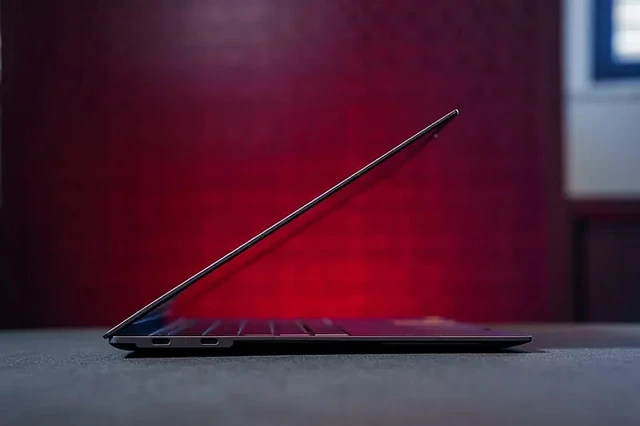 The Evolution of Ultrabooks: Driven by Solid-State Cooling