The global display market is on the precipice of a technological paradigm shift, one poised to upend the industry's established hierarchy. For years, the hegemony of South Korean titans has been underpinned by capital-intensive manufacturing processes, which effectively erected formidable barriers to entry for potential challengers. However, the emergence of inkjet-printed OLED technology promises to slash production costs and catalyze the mass adoption of premium displays. TCL CSOT is betting heavily on this approach, aiming to fundamentally reshape the competitive landscape of the monitor and laptop markets.
TCL CSOT’s ambitions are anchored in a pivotal shift toward Inkjet Printing (IJP OLED) technology, a departure from the traditional vacuum evaporation method. While the classical process relies on costly fine metal masks and is plagued by significant material waste, IJP operates like a giant industrial printer, precisely depositing organic materials onto the substrate. This not only minimizes waste but also paves the way for the cost-effective production of larger panels—a critical factor for the monitor and laptop segments.
TCL CSOT’s strategy is based on incremental scaling. The first phase involved mastering mass production on Gen 5.5 lines. To refine the technological process and mitigate risks, the company initially targeted the medical sector—a niche market with uncompromising quality requirements. This expertise is now being transitioned into consumer-facing solutions, with validation programs currently underway for branded laptops and monitors.
The first significant market disruptor is expected to be a 27-inch UHD monitor tailored for the professional segment. This specific format was chosen strategically: professionals prioritize color accuracy and contrast over price, providing TCL with an ideal environment to test the capabilities of IJP OLED under real-world conditions. These panels are currently undergoing rigorous evaluation by leading display manufacturers across China, Taiwan, and South Korea. The next logical step is an expansion into the mobile sector, with the mass production of IJP OLED laptop panels scheduled for the third quarter of 2026.
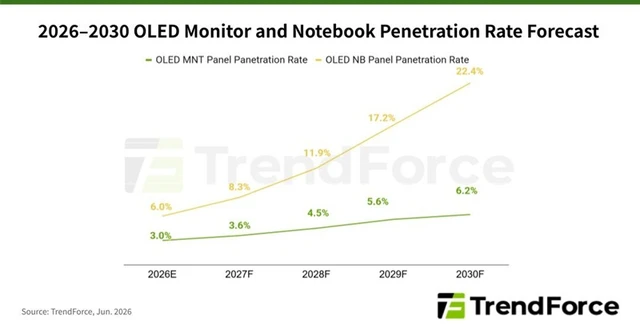
Historically, the OLED monitor market has been a closed ecosystem, with Samsung Display and LG Display maintaining near-absolute control. Limited production capacity has meant that even by 2026, OLED's share of total monitor shipments is projected to be only around 3%. However, TCL CSOT’s investments in Gen 8.6 lines are poised to shift this dynamic. Transitioning to larger glass substrates allows for a higher yield of panels per sheet, substantially reducing the cost per unit. Forecasts suggest this could push OLED monitor penetration to 6.2% by 2030, with the potential for subsequent exponential growth.
The laptop segment is evolving even more dynamically. While Samsung Display maintains its lead, the market is becoming increasingly diversified. Chinese players, including Everdisplay Optronics, have begun aggressively strengthening their positions, and OLED penetration in laptops is expected to reach 6% within the current year.
The global race for dominance has now shifted to the realm of Gen 8.6 infrastructure investment. Alongside TCL CSOT, BOE and Visionox have entered the fray. Notably, BOE has already launched production for laptop and tablet panels at its Chengdu facility. This consolidation of Chinese manufacturing prowess creates a formidable counterweight to the South Korean giants. Consequently, by 2030, OLED screens could capture up to 22.4% of the total laptop market, evolving from a premium niche into a new industry standard.
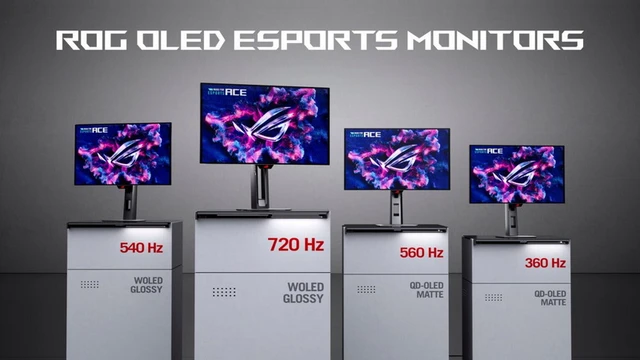 The Speed Limits of Modern Gaming Displays