For decades, the desktop computing landscape remained virtually unipolar, with Microsoft’s hegemony appearing absolute. Recent data, however, signal the onset of a tectonic shift in the balance of power among the industry's key players. For the first time in years, Windows' market share has dipped below the critical 60% threshold, carving out significant room for alternative ecosystems. This trend is more than a mere technical evolution; it represents a fundamental realignment of user priorities in a post-monopoly era.
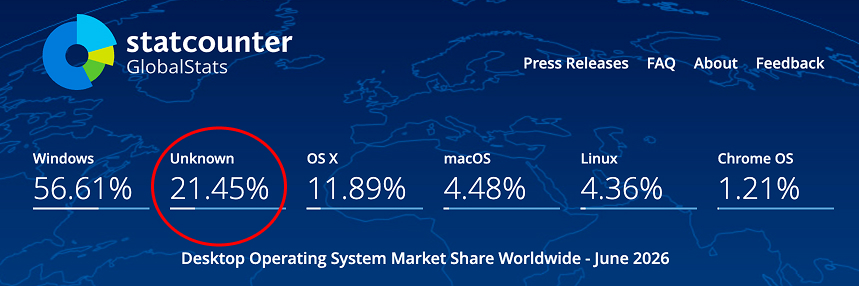
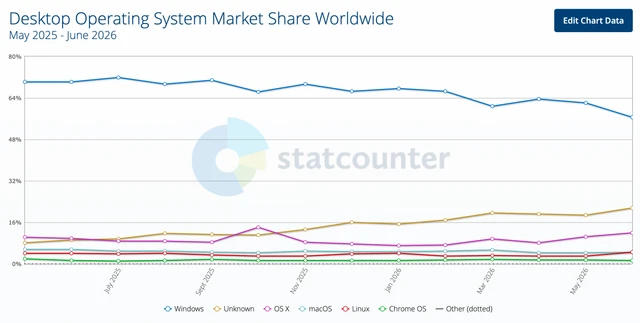
The global desktop operating system market, long resembling an impregnable fortress held by Microsoft, is showing its first signs of serious erosion. According to fresh data from StatCounter for June 2026, Windows' market share has dipped to 56.55%. This sharp decline is particularly striking when contrasted with the previous month, where the system maintained a hold of approximately 63%. Such dynamics suggest that the era of a single platform's absolute hegemony over the desktop segment is drawing to a close.
Against this backdrop, alternative ecosystems are seeing steady growth. Linux, long relegated to a niche utility for developers and system administrators, continues to consolidate its position, reaching 4.39%—one of the highest figures in its recorded history. Simultaneously, Apple's platforms maintain a substantial footprint, with the combined share of OS X and macOS exceeding 16%, while Chrome OS holds a modest but stable 1.21%.
However, when analyzing these figures, it is crucial to consider the nuances of StatCounter's methodology. The service does not track installed software; rather, it analyzes traffic across millions of websites. Consequently, we are observing not so much the number of physical devices as we are the level of online user activity.
This counting quirk has sparked a spirited debate within the professional community, most notably on Reddit. Experts have pointed to an anomalous surge in the "Unknown" category, which now accounts for 21.45% of all traffic. Such a high percentage of unidentified systems could be the result of tightened privacy protocols in modern browsers—which mask OS data from third-party trackers—or an increase in bot traffic. In either case, this margin of error significantly impacts the final distribution and warrants a cautious approach to short-term fluctuations in the charts.
Nevertheless, from a long-term perspective, a systemic erosion of trust in the traditional leader becomes evident. The gradual exodus of users from the Windows ecosystem is driven by several factors. First, the stringent hardware requirements of Windows 11 are obsoleting a vast swath of functional hardware, forcing users to seek alternatives. Second, Microsoft's aggressive push toward service integration and data harvesting is fueling growing resentment.
Simultaneously, Linux is experiencing a genuine renaissance, one that would have been impossible without the evolution of gaming technology. The arrival of the Steam Deck and the implementation of the Proton compatibility layer have dismantled the primary hurdle for mass adoption: the lack of a comprehensive gaming experience. Today, open-source systems are shedding their "complex" reputation, emerging as viable, aesthetic, and high-performance alternatives to the established standard, steadily chipping away at Microsoft's monopoly.
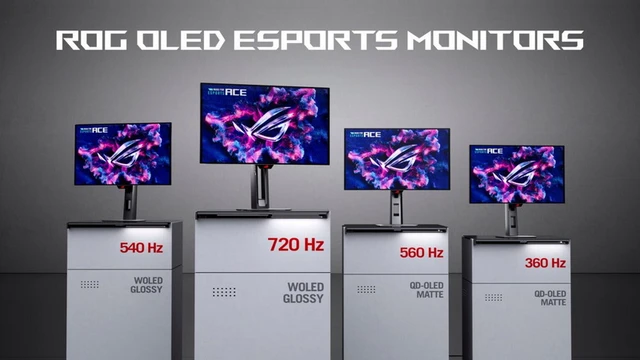 The Speed Limits of Modern Gaming Displays