Autonomous navigation in extreme environments remains one of the most formidable challenges in modern robotics. Conventional optical systems and LiDAR often falter when faced with smoke, dust, or total darkness. The solution lies in biomimetics—leveraging the principles of haptic perception that living organisms employ to navigate their surroundings. Researchers at Delft University of Technology have introduced a novel concept of tactile control tailored for ultralight drones. This approach paves the way for autonomous systems capable of operating effectively in environments where visual perception is rendered obsolete.
In the modern UAV industry, there is a fundamental tension between a device's weight and its capacity for environmental perception. True autonomy demands cameras and LiDAR, yet their mass and power consumption are prohibitive for micro-UAVs weighing under 100 grams. Furthermore, optical navigation becomes obsolete in dense smoke, dust, or total darkness, rendering it impractical for search-and-rescue operations in collapsed structures or the exploration of narrow subterranean conduits.
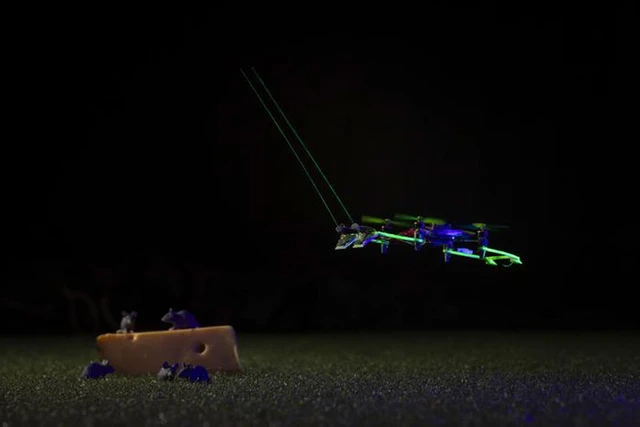
An alternative solution has emerged through the application of vibrissae—the sensitive whiskers rodents use to navigate their surroundings. Engineers have implemented this concept by equipping the drone's prow with a pair of flexible synthetic sensors. The system operates by registering mechanical deflection: three miniature pressure sensors are located at the base of each "whisker." When a sensor encounters an obstacle, the resulting pressure shift allows the system to determine the contact vector, the distance to the object, and its precise spatial position with high accuracy.
Integrating a tactile interface into a flight vehicle presents a significant technical hurdle: signal noise. By nature, a drone is a source of intense vibration, and the propellers generate powerful turbulent air currents that the system could easily misinterpret as physical contact. To mitigate this, a specialized controller and data-filtering algorithm were developed to isolate the signal from the noise.
The level of optimization is particularly noteworthy: the entire computational pipeline runs directly on the onboard microcontroller, occupying a mere 34 KB of memory. This efficiency enables millimeter-level positioning precision without overloading the processor or increasing the system's power draw.
Field tests have validated the viability of this approach. The UAV demonstrated the ability to navigate confidently along surfaces of varying rigidity and follow wall contours in absolute darkness. The system enabled the drone to autonomously generate tactile maps of unknown environments and locate exits, relying solely on physical contact without the need for external localization systems or visual landmarks.
This paradigm shift from "vision" to "touch" heralds the emergence of a new class of ultra-compact autonomous robots. In the future, such systems will become indispensable tools in scenarios where traditional sensors are powerless: from locating survivors in smoke-filled buildings following industrial disasters to mapping narrow caves and technical tunnels, where every gram of weight and every byte of memory is critical.
 Forecasting Exponential Growth in Nvidia Shipments