The breakneck pace of generative AI adoption in software development has precipitated a dangerous paradox: code is now being authored faster than security systems can validate it. This technological rift has triggered an avalanche of vulnerabilities and a deluge of false positives, leaving SecOps teams paralyzed. Cognition proposes a solution with the Devin Security Swarm—a system of autonomous agents capable of independently hunting for and remediating flaws. The battle against the fallout of "AI-driven coding" is evolving into an automated confrontation between peer systems.
The modern software development lifecycle is facing a scaling crisis. With nearly half of all codebases now augmented by AI, the potential attack surface is expanding exponentially. For many enterprises, scanner alerts have surged tenfold or even hundredfold in a short window, turning security audits into an endless battle against noise and false positives. In this environment, traditional static analysis tools are proving inadequate, as they lack the capacity to grasp the nuances of business logic.
Enter Devin Security Swarm—a tool that translates the concept of swarm intelligence into the realm of cybersecurity. At its core lies an "Agentic MapReduce" approach. Rather than sequential file scanning, a swarm of parallel agents investigates various segments of the codebase simultaneously. Each agent is capable of analyzing interdependencies across multiple files, enabling the detection of complex exploit chains and authorization bypasses that typically evade superficial analysis.
The system's primary differentiator from legacy security tools is its verification phase. Devin doesn't simply flag a suspicious code snippet; it deploys an isolated sandbox to attempt a real-time reproduction of the attack. Only after a vulnerability is confirmed via a practical exploit does the system proceed to generate a patch and initiate a pull request for review. Consequently, security engineers receive concrete cases backed by evidence and ready-made solutions, rather than a list of hypothetical risks.
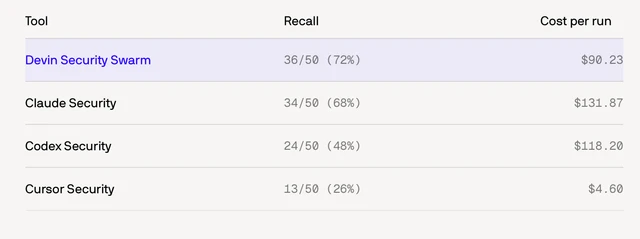
The efficacy of this approach is validated by benchmarks using real-world data from GitHub Security Advisories. In a test spanning 14 programming languages—ranging from the rigor of Go to the flexibility of Python and the specificity of Elixir—Devin Security Swarm achieved an accuracy rate of 72%, identifying 36 out of 50 known vulnerabilities. This significantly outperforms other specialized AI tools, such as Claude Security or Cursor Security.
Particularly valuable is the system's ability to uncover critical flaws that competitors overlook. Notably, the agent swarm successfully identified a PHP sandbox escape via template injection and deserialization vulnerabilities in Spring Kafka. These examples highlight the system's deep analytical potential: it understands complex component interactions rather than merely searching for known error patterns.
From an operational standpoint, implementing such a tool shifts the paradigm of managing technical debt. For organizations burdened by a massive backlog of accumulated CVEs, a two-stage transition strategy is proposed: first, a deep cleansing of existing code driven by a synergy of human experts and AI, followed by a shift to continuous monitoring. In this mode, the swarm analyzes only modified code segments, drastically reducing the total cost of ownership and transforming security from a periodic checkpoint into an organic component of the development process.
 Anthropic’s Strategic Push for Hardware Independence