The cosmos harbors phenomena that challenge our fundamental understanding of the universe's architecture. Conventional wisdom dictates that supermassive black holes reside strictly at the galactic center, serving as the gravitational anchors for their respective systems. However, the detection of a rare tidal disruption event (TDE) occurring outside the galactic nucleus upends this long-held paradigm. The case of TDE 2025abcr provides empirical evidence of "wandering" behemoths capable of obliterating stars within the depths of interstellar space.
In the constellation Cetus, approximately 750 million light-years from Earth, an event has been recorded that astrophysicists define as a Tidal Disruption Event (TDE). A flash of staggering power erupted within galaxy WISEA J014656.04−152214.7, but its localization left scientists baffled: the epicenter was not in the galactic core—the typical residence of supermassive black holes—but over 30,000 light-years away from the center. This suggests that the star was not consumed by a stationary object, but by a wandering gravitational colossus.
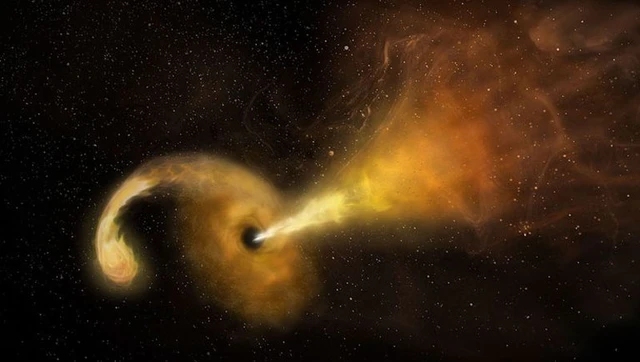
The mechanics of tidal disruption represent one of the most violent scenarios in astrophysics. When a star ventures within a specific critical radius of a black hole, the differential gravitational pull between its near and far sides becomes so extreme that the stellar body is literally torn asunder. While much of the stellar matter is scattered into space, a portion is captured by the black hole, forming a searing accretion flow that generates the intense radiation visible across millions of light-years.
The detection of event TDE 2025abcr was made possible through the convergence of advanced observational technology and data analytics. In the autumn of 2025, the Zwicky Transient Facility observatory flagged an anomalous surge in brightness on the periphery of a distant galaxy. From hundreds of thousands of variable objects, this specific source was isolated by a specialized machine-learning algorithm, underscoring the growing role of AI in modern astronomy. Over four weeks, the flare intensified, peaking on November 14. In the ultraviolet spectrum, the emission was so potent that it eclipsed the light of its entire parent galaxy for several months; at its zenith, the object's total luminosity was equivalent to the energy of over 10 billion Suns.
To verify the nature of the flare, NASA’s Swift observatory was brought into play. Spectral analysis allowed researchers to rule out a classic supernova—the collapse of a massive star. Instead, the data pointed toward an object with a mass of approximately one million solar masses. Notably, the central black hole of this same galaxy is expected to be significantly more massive—likely by two orders of magnitude compared to the wandering interloper.
The question of how such "outcasts" originate remains open, and science proposes two primary scenarios. The first suggests a process of galactic cannibalism: a larger galaxy consumed a dwarf system, bringing along a black hole that maintained its orbit on the outskirts. The second scenario involves dynamical chaos within the galactic center. During an interaction between three supermassive black holes, a gravitational slingshot effect can occur, effectively ejecting the smallest of the objects from the core toward the periphery.
Tidal disruption events are becoming essential tools for mapping the "dark" population of the universe. Wandering black holes are virtually impossible to detect directly until they interact with a star. This implies that such invisible threats may exist within our own galaxy, remaining undetected until the moment of catastrophe. In the near future, the search for these objects will enter a new era with the launch of the Vera C. Rubin Observatory and NASA’s Nancy Grace Roman Space Telescope, which will enable the systematic tracking of such flares across the observable cosmos.
 Anthropic’s Strategic Financial Surge Ahead of Its IPO